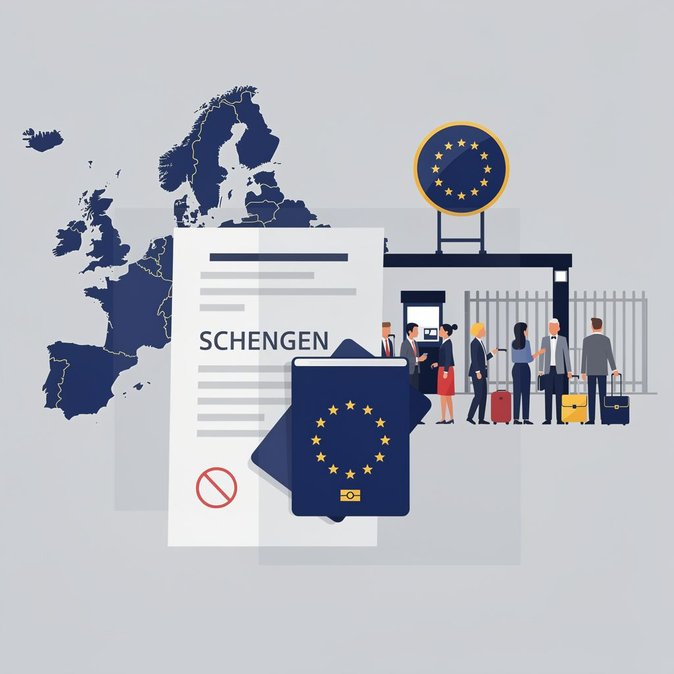
The EU Council’s Visa Working Party convened in Brussels on 25 June to review a draft ‘assessment framework’ that will determine how third-country nationals qualify for short-stay visa-free access. France’s delegation argued for heavier weighting of overstay statistics and asylum-application ratios, contending that current metrics underestimate the compliance gap at Paris-Charles-de-Gaulle and secondary airports.
Organisations concerned about sudden shifts in visa-waiver eligibility can streamline their contingency planning through VisaHQ, which offers real-time monitoring of EU policy developments, automated alerts for specific nationalities, and a digital platform to generate the supporting documents—proof of funds, itineraries, onward tickets—that border officers increasingly request. Learn more at https://www.visahq.com/france/
Under the proposal, countries whose nationals exceed a 2 % overstay rate—or whose asylum claims in the EU surpass 6,000 annually—could see their visa exemption suspended within six months unless corrective action is taken. That would tighten the 2018 mechanism, which France has long criticised as “bureaucratically toothless.” Diplomats say the move is partly aimed at Western Balkan states, but could also affect Gulf and Caribbean jurisdictions popular with business travellers. If adopted, the rules would empower member states to demand additional data—such as onward-ticket proof or financial guarantees—at the Schengen border, even for currently exempt nationalities. French border police have already piloted such checks at Nice Côte d’Azur during the Cannes Film Festival, and report a 22 % rise in refusals of entry compared with 2025. Employers moving short-term assignees into France should watch the Council agenda: a first reading is pencilled in for October, and the French Interior Ministry is preparing an implementation circular that could come into force as early as Q1 2027. Companies may soon need to pre-clear documentation for travellers who today enjoy visa-free status.
Organisations concerned about sudden shifts in visa-waiver eligibility can streamline their contingency planning through VisaHQ, which offers real-time monitoring of EU policy developments, automated alerts for specific nationalities, and a digital platform to generate the supporting documents—proof of funds, itineraries, onward tickets—that border officers increasingly request. Learn more at https://www.visahq.com/france/
Under the proposal, countries whose nationals exceed a 2 % overstay rate—or whose asylum claims in the EU surpass 6,000 annually—could see their visa exemption suspended within six months unless corrective action is taken. That would tighten the 2018 mechanism, which France has long criticised as “bureaucratically toothless.” Diplomats say the move is partly aimed at Western Balkan states, but could also affect Gulf and Caribbean jurisdictions popular with business travellers. If adopted, the rules would empower member states to demand additional data—such as onward-ticket proof or financial guarantees—at the Schengen border, even for currently exempt nationalities. French border police have already piloted such checks at Nice Côte d’Azur during the Cannes Film Festival, and report a 22 % rise in refusals of entry compared with 2025. Employers moving short-term assignees into France should watch the Council agenda: a first reading is pencilled in for October, and the French Interior Ministry is preparing an implementation circular that could come into force as early as Q1 2027. Companies may soon need to pre-clear documentation for travellers who today enjoy visa-free status.