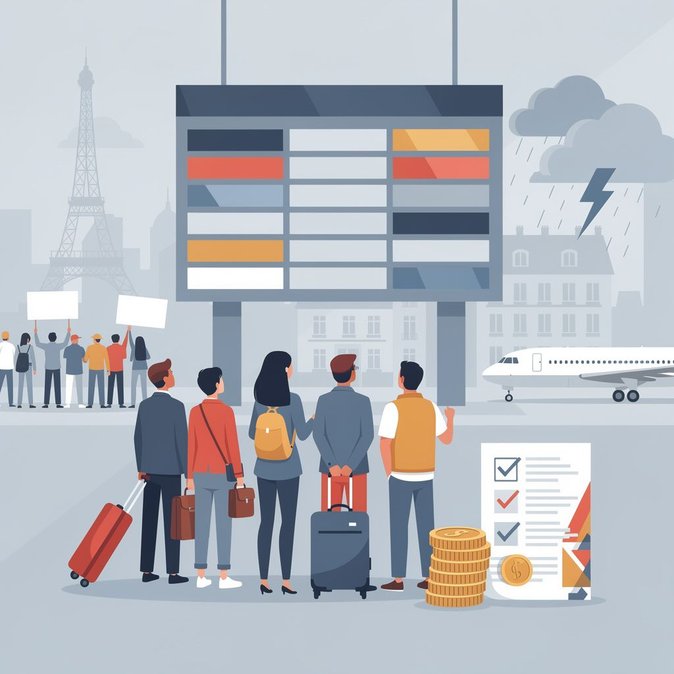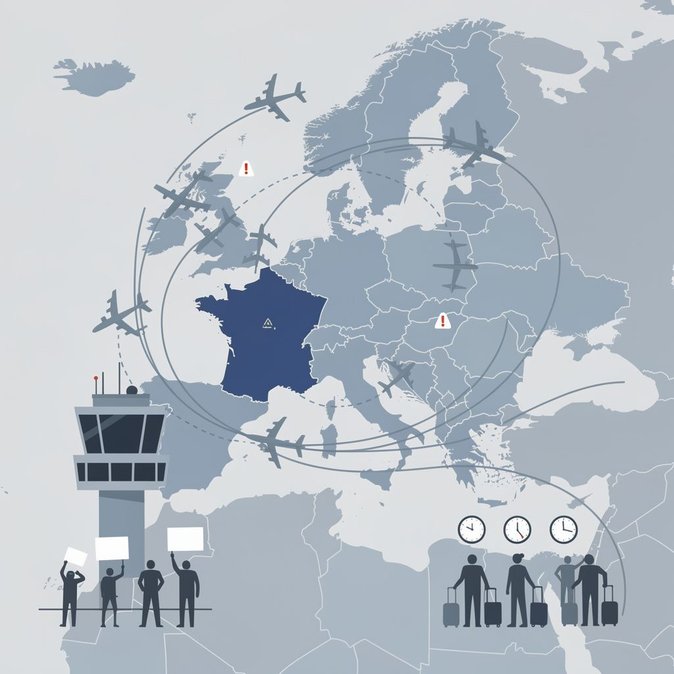
France’s air-traffic-control (ATC) unions launched a fresh 24-hour stoppage on 25 June that coincides with similar walk-outs in Spain, Italy, Belgium, Portugal, Germany and Greece. The synchronised action has been dubbed an “aviation meltdown” by industry site Travel & Tour World and is already rippling across Europe’s interconnected air-space corridors. Eurocontrol data show average en-route delays climbing above 60 minutes on key north-south sectors that route via French skies. The dispute in France is led by SNCTA and UNSA-ICNA, who are demanding an accelerated recruitment plan and pay increases back-dated to January, arguing that chronic staff shortages have left only 75 % of controller positions filled this summer. Unions deliberately targeted the last working Thursday of June, a peak change-over day for both corporate travellers and early-holiday traffic. Air France, easyJet, Lufthansa and KLM pre-emptively scrubbed more than 1 000 rotations, while Ryanair warns of 250 000 displaced passengers because overflights must be rerouted around French air-space. Business-travel managers are scrambling to re-book client-facing staff through rail or private-charter options. Amex GBT says same-day one-way Paris–Frankfurt fares on high-speed rail have risen from €149 to €292, while private-jet broker Victor reports a 41 % spike in quotation requests. Cargo operators are equally exposed: FedEx’s Paris-Charles-de-Gaulle hub handles 1 000 movements daily and must absorb knock-on delay costs estimated at €400 000 per day in crew overtime and missed delivery windows. Practical advice for companies includes activating split-team policies, checking flights inside Eurocontrol’s Flow Management Position (FMP) portal, and reminding employees that ATC strikes are classed as an “extraordinary circumstance” under EU 261—meaning airlines owe duty-of-care and re-routing but not cash compensation. For critical itineraries before 30 June, travel-risk consultancies suggest routing via Scandinavia or Switzerland, whose skies remain uncongested. Longer-term, the stand-off underscores EU airlines’ call for a Single European Sky that would allow them to avoid French air-space bottlenecks during domestic disputes.
Source: Travel and Tour World