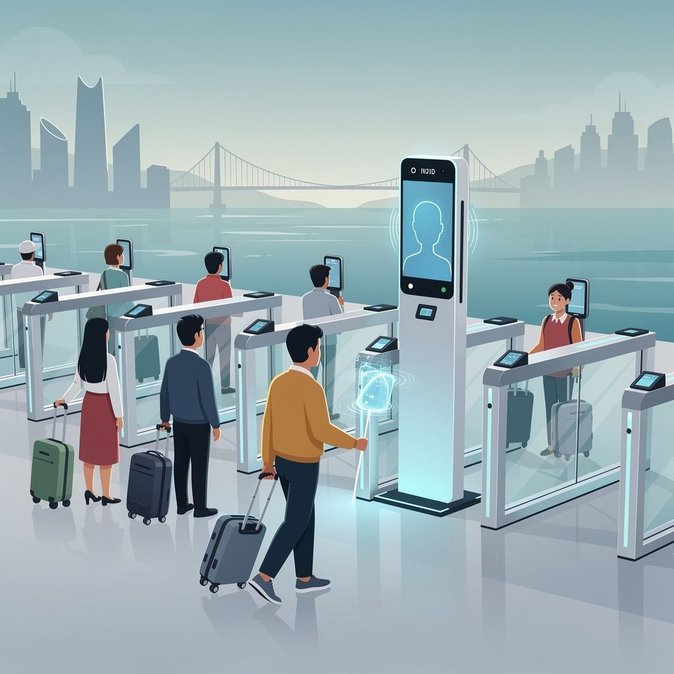
Macau’s Public Security Police Force confirmed on 25 June that its Smart Immigration Clearance system will be switched on at Qingmao Port and at the Zhuhai-Macao Hall of the Hong Kong-Zhuhai-Macao Bridge (HZMB) control building at 00:00 on 26 June. The expansion adds 204 automated channels across all joint-inspection ports and allows eligible travellers—including Hong Kong permanent residents—to clear both exit and entry with a single facial scan. The document-free procedure replaces the traditional card-scan process: passengers who have pre-registered their biometric data simply walk through the lane while cameras match their face to the border database. Physical passports or ID cards must still be carried for spot checks, but need not be presented unless prompted. Smart Clearance was first rolled out at Hengqin Port last November, where it now accounts for 42 per cent of all crossings—6.21 million passengers to date. Authorities say 170,000 people have already registered for the new ports during trial operations, completing 1.72 million scans without major glitches. The upgrade is expected to cut average clearance time to under ten seconds, a boon for business travellers who shuttle daily between Hong Kong, Zhuhai and Macau’s Cotai business districts. It also dovetails with Hong Kong’s own seamless e-Channel launch, signalling a Greater Bay Area push towards fully biometric, 24-hour border zones that support the region’s integrated labour and tourism markets. HR and mobility managers should inform staff that Hong Kong permanent residents aged 14 and above are eligible at the new Macau lanes, provided they complete online enrolment. Frequent flyers may wish to register on both sides of the boundary to guarantee the fastest passage regardless of travel direction.
Source: Asia Gaming Brief