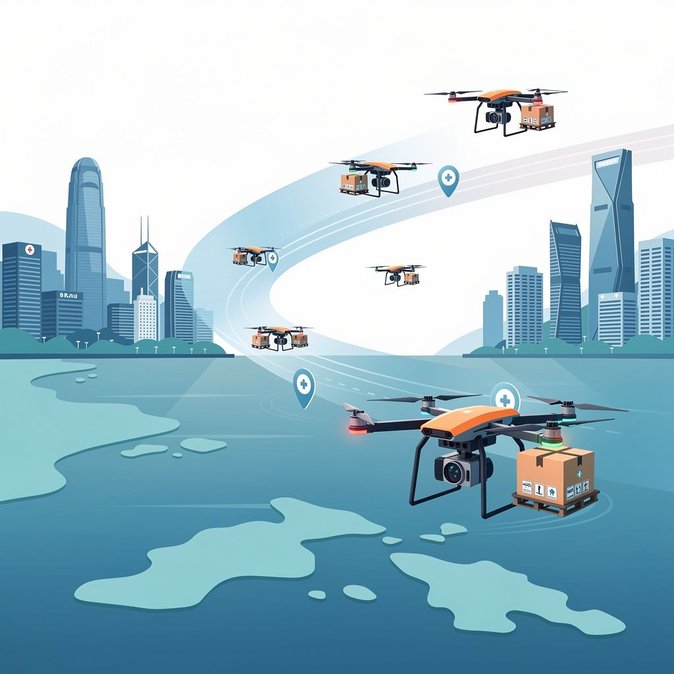
Hong Kong’s Transport and Logistics Bureau has confirmed that it is working with mainland regulators to launch experimental cross-border “low-altitude logistics” flights, aiming to create an air-corridor for time-critical goods between the SAR and neighbouring Guangdong cities. Speaking in a Legislative Council session on 24 June, Secretary for Transport and Logistics Lam Sai-hung said the trials will be carried out under the upgraded “Regulatory Sandbox X” framework that the Government introduced last November for more complex unmanned-aircraft operations. The move builds on Hong Kong’s fast-growing drone ecosystem: of 38 original sandbox projects announced last year, more than 20—including facade cleaning, infrastructure inspection and light-show services—have already moved into routine commercial operation. The cross-boundary phase will test five technically demanding scenarios such as unmanned-traffic-management (UTM) systems, long-range eVTOL cargo craft and multi-operator shared platforms. Fifteen UTM demonstration sites and four non-traditional aircraft pilots have been green-lit for staged deployment starting this summer. For international firms running supply-chain or maintenance hubs in the Greater Bay Area, drone corridors could eventually shrink Shenzhen–Hong Kong pickup windows from hours to under 30 minutes, unlocking same-day spare-parts delivery and high-value biomedical transport. The Bureau said it will prioritise routes that carry urgent medical supplies, lab samples and premium e-commerce parcels, markets where reliability and customs efficiency command price premiums. Key hurdles remain: Hong Kong’s Air Navigation (Hong Kong) Order requires every unmanned aircraft exceeding 7 kg to obtain a flight permit, while mainland rules still limit civil drones above certain weights or beyond visual line of sight (BVLOS) without extensive approvals. Officials therefore plan to run the first BVLOS flights as point-to-point “proof-of-concept” missions between designated customs supervision zones, streamlining clearance through pre-lodged digital manifests and blockchain-based tracking. Companies involved in cross-border distribution should monitor the sandbox calls for proposals expected in Q3 2026. Early engagement can position enterprises to shape flight-path planning, ground-station locations and data-exchange standards, giving them a competitive head-start once the Greater Bay Area’s low-altitude economy scales up.