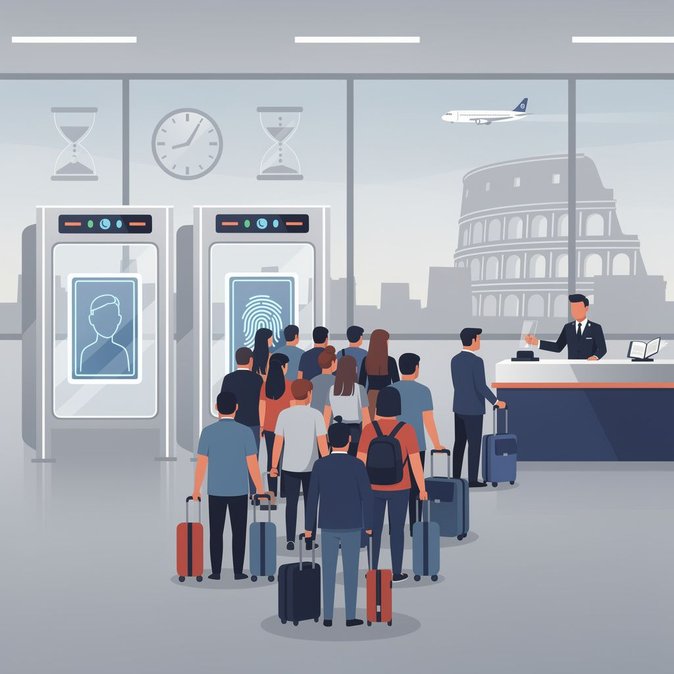
Less than three months after the EU’s new Entry/Exit System (EES) became mandatory at Italy’s external air borders, the country’s largest airport operator is sounding the alarm. Speaking to the Financial Times, Aeroporti di Roma (AdR) CEO Marco Troncone warned that biometric enrolment queues are already stretching to two-plus hours at Rome-Fiumicino and Ciampino—even before the traditional July–August passenger surge.
The EES replaces manual passport stamping for non-EU short-stay visitors with a fingerprint and facial-image scan recorded in a shared Schengen database. Under EU rules, member states may invoke a “flexibility clause” allowing checkpoints to revert to manual stamping for up to six hours when waiting times exceed 45 minutes. AdR is lobbying the Italian Interior Ministry to use that clause pre-emptively, or to issue an emergency decree authorising a blanket suspension of EES at Rome’s airports until 30 September. Government sources told The Local, however, that Rome has so far assured Brussels it does not intend to shelve the system nationally.
Airlines, ground-handling companies and corporate travel managers are watching closely. A partial suspension could ease passenger throughput but would create a messy mix of digital and manual exit records, complicating the calculation of each traveller’s remaining Schengen-area allowance. Carriers that rely on automated Advance Passenger Information (API) matching may need manual work-arounds, while mobility teams would have to brief assignees on keeping boarding passes and stamp images as proof of compliance.
For travellers trying to navigate these shifting rules, VisaHQ can help cut through the complexity. The service’s dedicated Italy page (https://www.visahq.com/italy/) consolidates the most up-to-date visa and border-entry requirements, tracks EES developments in real time, and offers tailored assistance to corporations and individuals planning trips—making it easier to stay compliant while avoiding last-minute surprises.
If Italy does pause EES—even locally—it will give other Schengen hubs political cover to follow suit. Border-control unions at Paris-Charles de Gaulle and Madrid-Barajas are already predicting “chaos” in July. Conversely, should the government hold the line, travellers can expect reinforced staffing, more pre-enrolment kiosks and a public-information campaign urging non-EU visitors to arrive at least three hours early.
Either way, companies should update travel-risk assessments now. Crew rotations, tight connection itineraries and same-day business meetings in Rome may need re-timing; duty-of-care teams should track the Interior Ministry’s bulletin page and airlines’ operational notices for real-time changes to border procedures.
The EES replaces manual passport stamping for non-EU short-stay visitors with a fingerprint and facial-image scan recorded in a shared Schengen database. Under EU rules, member states may invoke a “flexibility clause” allowing checkpoints to revert to manual stamping for up to six hours when waiting times exceed 45 minutes. AdR is lobbying the Italian Interior Ministry to use that clause pre-emptively, or to issue an emergency decree authorising a blanket suspension of EES at Rome’s airports until 30 September. Government sources told The Local, however, that Rome has so far assured Brussels it does not intend to shelve the system nationally.
Airlines, ground-handling companies and corporate travel managers are watching closely. A partial suspension could ease passenger throughput but would create a messy mix of digital and manual exit records, complicating the calculation of each traveller’s remaining Schengen-area allowance. Carriers that rely on automated Advance Passenger Information (API) matching may need manual work-arounds, while mobility teams would have to brief assignees on keeping boarding passes and stamp images as proof of compliance.
For travellers trying to navigate these shifting rules, VisaHQ can help cut through the complexity. The service’s dedicated Italy page (https://www.visahq.com/italy/) consolidates the most up-to-date visa and border-entry requirements, tracks EES developments in real time, and offers tailored assistance to corporations and individuals planning trips—making it easier to stay compliant while avoiding last-minute surprises.
If Italy does pause EES—even locally—it will give other Schengen hubs political cover to follow suit. Border-control unions at Paris-Charles de Gaulle and Madrid-Barajas are already predicting “chaos” in July. Conversely, should the government hold the line, travellers can expect reinforced staffing, more pre-enrolment kiosks and a public-information campaign urging non-EU visitors to arrive at least three hours early.
Either way, companies should update travel-risk assessments now. Crew rotations, tight connection itineraries and same-day business meetings in Rome may need re-timing; duty-of-care teams should track the Interior Ministry’s bulletin page and airlines’ operational notices for real-time changes to border procedures.