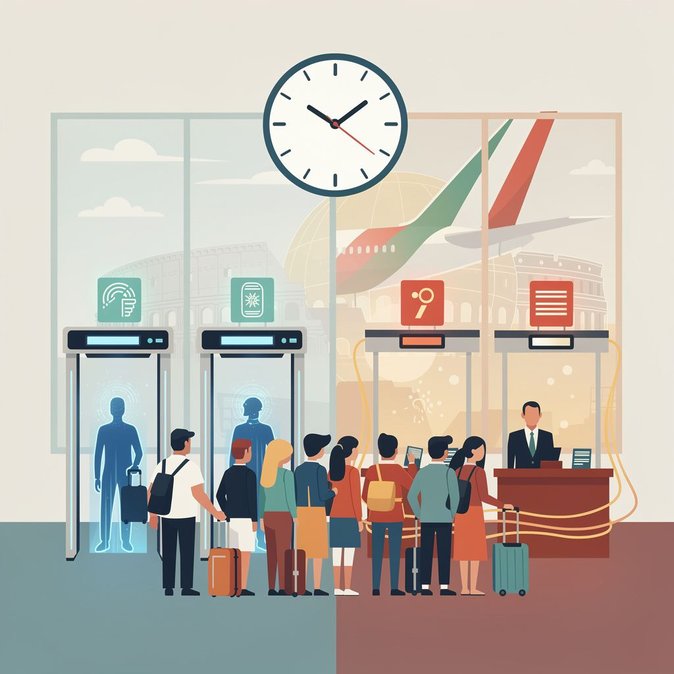
Rome’s two major airports—Leonardo da Vinci (Fiumicino) and G.B. Pastine (Ciampino)—are weighing an emergency suspension of the EU’s new Entry/Exit System (EES) for non-EU travellers as passenger volumes surge in July and August. EES, which became mandatory for Italy on 10 April 2026 after an eighteen-month pilot, digitally records travellers’ fingerprints and facial images instead of stamping passports. While the system promises stronger border security and automatic over-stay alerts, enrolment takes 45-90 seconds per person.
For travelers looking to stay ahead of Italy’s evolving border formalities, VisaHQ can help streamline the process. Its dedicated Italy page (https://www.visahq.com/italy/) tracks real-time changes to EES, ETIAS, and visa policies, offers step-by-step application guidance, and provides expert document review—tools that can minimize surprises at the checkpoint and keep your trip on schedule.
Aeroporti di Roma (AdR) chief executive Marco Troncone told the Financial Times he is “eight or nine out of ten” worried that the process is “incompatible with peak volumes”, warning of “disaster-level” queues that could ripple across the Schengen network. EU rules allow member states to pause EES for up to six hours when queues exceed 45 minutes, but Italian media have leaked draft decrees that would let airports revert to manual stamping until 30 September. The government has not confirmed a blanket waiver, leaving AdR to prepare its own contingency protocols. Under discussion: dynamic queue-length monitoring, triage lanes for families and crew, and temporary re-deployment of border officers from quieter checkpoints. For business travellers, the uncertainty means longer connection buffers and the possibility that passport controls will flip between biometric and manual modes with little notice. Mobility managers are advising travellers to carry printed boarding passes, arrive at least three hours early for long-haul flights, and monitor AdR and Polizia di Frontiera social channels for real-time alerts. If Rome presses pause on EES, other high-volume Italian gateways—Milan Malpensa, Venice Marco Polo and Naples Capodichino—could follow, potentially slowing the EU’s wider digital-border rollout ahead of ETIAS in late 2026. The episode is already fuelling debate in Brussels over whether airlines or airports should shoulder the cost of additional kiosks and staffing needed to make biometric controls work during peak season.
For travelers looking to stay ahead of Italy’s evolving border formalities, VisaHQ can help streamline the process. Its dedicated Italy page (https://www.visahq.com/italy/) tracks real-time changes to EES, ETIAS, and visa policies, offers step-by-step application guidance, and provides expert document review—tools that can minimize surprises at the checkpoint and keep your trip on schedule.
Aeroporti di Roma (AdR) chief executive Marco Troncone told the Financial Times he is “eight or nine out of ten” worried that the process is “incompatible with peak volumes”, warning of “disaster-level” queues that could ripple across the Schengen network. EU rules allow member states to pause EES for up to six hours when queues exceed 45 minutes, but Italian media have leaked draft decrees that would let airports revert to manual stamping until 30 September. The government has not confirmed a blanket waiver, leaving AdR to prepare its own contingency protocols. Under discussion: dynamic queue-length monitoring, triage lanes for families and crew, and temporary re-deployment of border officers from quieter checkpoints. For business travellers, the uncertainty means longer connection buffers and the possibility that passport controls will flip between biometric and manual modes with little notice. Mobility managers are advising travellers to carry printed boarding passes, arrive at least three hours early for long-haul flights, and monitor AdR and Polizia di Frontiera social channels for real-time alerts. If Rome presses pause on EES, other high-volume Italian gateways—Milan Malpensa, Venice Marco Polo and Naples Capodichino—could follow, potentially slowing the EU’s wider digital-border rollout ahead of ETIAS in late 2026. The episode is already fuelling debate in Brussels over whether airlines or airports should shoulder the cost of additional kiosks and staffing needed to make biometric controls work during peak season.