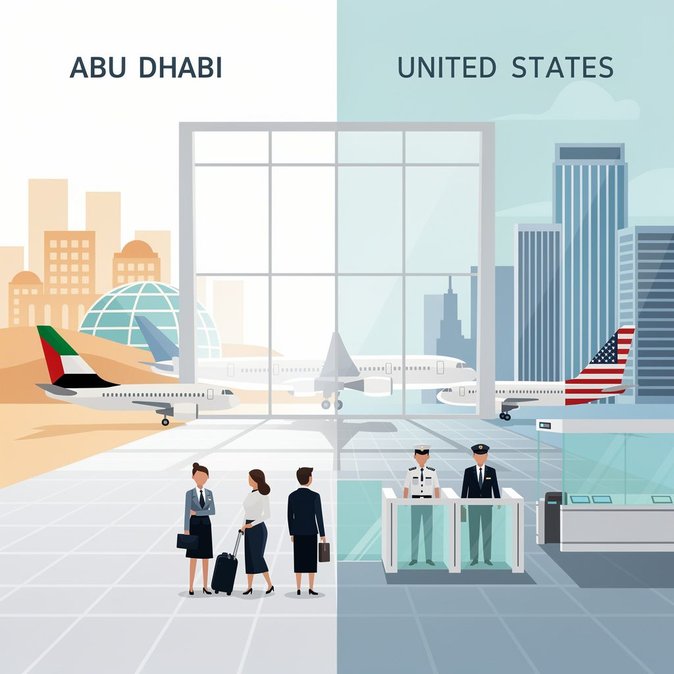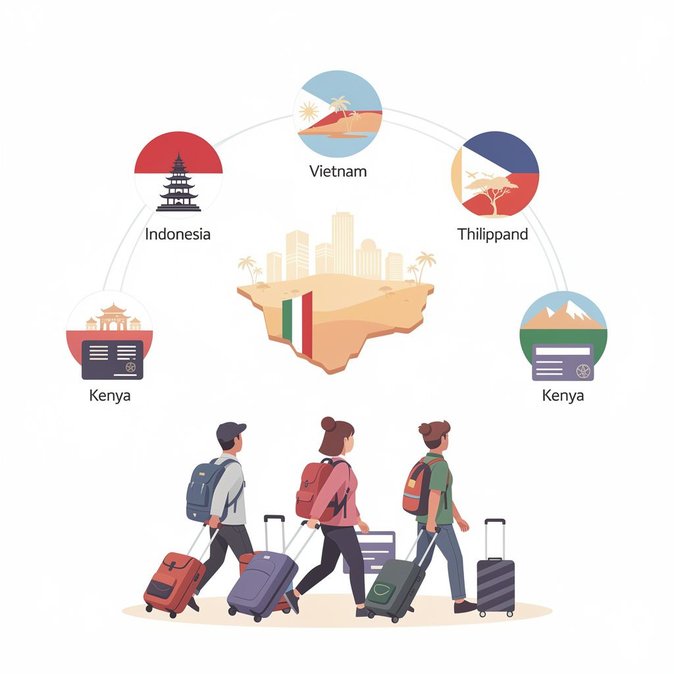
The United Arab Emirates has dramatically widened its popular visa-on-arrival programme, opening the door to millions of additional leisure and business visitors. In a joint statement released late on 25 June 2026, the Ministry of Foreign Affairs and the Federal Authority for Identity, Citizenship, Customs and Port Security (ICP) confirmed that ordinary-passport holders from Indonesia, Vietnam, Thailand, the Philippines, Kenya and South Africa are now eligible for visas on arrival at all UAE airports and land borders. The new nationalities join the existing roster of more than 80 countries whose citizens can obtain permission to enter at the border rather than applying in advance. To qualify, travellers must also hold a valid residence permit or long-term visa for one of ten “benchmark” jurisdictions—including the United States, United Kingdom, any EU member state, Australia, Japan, Singapore, South Korea, Canada or New Zealand—with at least six months’ validity remaining. Family members travelling with a qualifying resident are covered by the same concession.
For anyone needing additional guidance, VisaHQ’s dedicated UAE team (https://www.visahq.com/united-arab-emirates/) keeps abreast of the latest ICP updates and can pre-screen documents, arrange express extensions and issue timely compliance reminders, ensuring a smooth arrival experience even under the new rules.
Two fee-based options are available. A 14-day, single-entry visa costs AED 100 (≈ US$27) and can be extended once for another 14 days at AED 250. Alternatively, a 60-day non-extendable visa costs AED 250 (≈ US$68). The visas are issued at dedicated counters immediately after biometric capture and payment, and holders may move freely between all seven emirates during their stay. Officials framed the decision as part of a broader push to keep the UAE at the forefront of global connectivity. The six countries represent some of the world’s fastest-growing outbound travel markets and key sources of skilled labour. By lowering the administrative barrier to entry, the UAE hopes to entice more stop-over visitors on long-haul routes, encourage SME traders to attend the autumn trade-fair season, and strengthen its reputation as a neutral hub for African–Asian commerce. Corporate mobility managers should update travel-policy matrices immediately: employees who hold both an eligible passport and a qualifying third-country residence permit can now travel to the UAE at short notice without sponsor support. However, employers should still confirm that insurance coverage, payroll presence and tax triggers remain compliant for stays beyond 14 days, and remind travellers that over-stays incur daily fines after the visa expires.
For anyone needing additional guidance, VisaHQ’s dedicated UAE team (https://www.visahq.com/united-arab-emirates/) keeps abreast of the latest ICP updates and can pre-screen documents, arrange express extensions and issue timely compliance reminders, ensuring a smooth arrival experience even under the new rules.
Two fee-based options are available. A 14-day, single-entry visa costs AED 100 (≈ US$27) and can be extended once for another 14 days at AED 250. Alternatively, a 60-day non-extendable visa costs AED 250 (≈ US$68). The visas are issued at dedicated counters immediately after biometric capture and payment, and holders may move freely between all seven emirates during their stay. Officials framed the decision as part of a broader push to keep the UAE at the forefront of global connectivity. The six countries represent some of the world’s fastest-growing outbound travel markets and key sources of skilled labour. By lowering the administrative barrier to entry, the UAE hopes to entice more stop-over visitors on long-haul routes, encourage SME traders to attend the autumn trade-fair season, and strengthen its reputation as a neutral hub for African–Asian commerce. Corporate mobility managers should update travel-policy matrices immediately: employees who hold both an eligible passport and a qualifying third-country residence permit can now travel to the UAE at short notice without sponsor support. However, employers should still confirm that insurance coverage, payroll presence and tax triggers remain compliant for stays beyond 14 days, and remind travellers that over-stays incur daily fines after the visa expires.