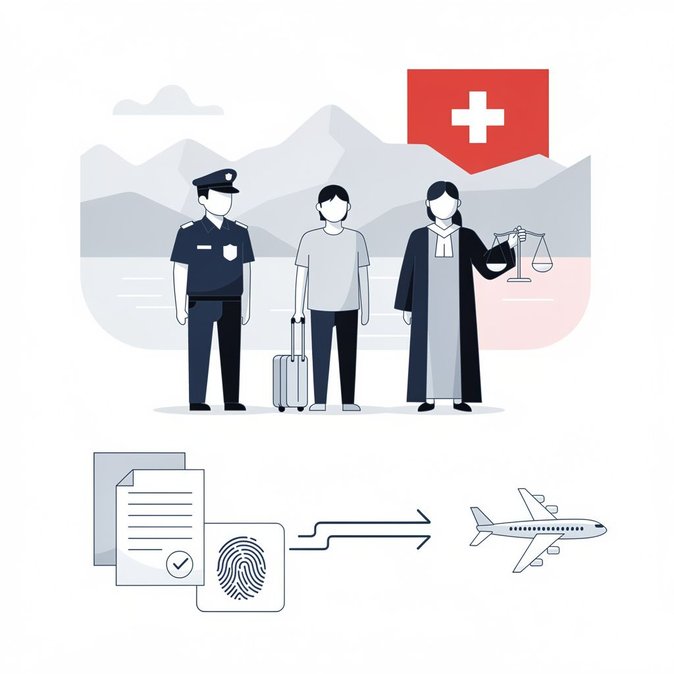
The Swiss State Secretariat for Migration (SEM) has published the six-month interim report on its pilot “Task-Force Intensivtäter” (TIA), a programme that coordinates criminal, police and migration authorities to deal with serious foreign offenders. Launched in June 2025 in ten cantons, the task-force acts as a case-management hub: as soon as an asylum-seeker or other foreign national becomes the subject of criminal proceedings, SEM, cantonal prosecutors, police and prison officials pool data and decide whether detention pending removal, Dublin transfers or other coercive measures can be triggered immediately. According to the report, 87 cases were taken on during the first half-year; about two-thirds involved people in the asylum system from countries with a very low recognition rate. 36 cases have already been resolved—either through actual departure or absconding—while 51 people remain in custody awaiting deportation.
Concrete measures include marking TIA cases in the central migration system (ZEMIS), flagging them in the Schengen Information System to facilitate detention at the border and accelerating Dublin transfers when prison sentences end. Employers, relocation consultancies and travellers who need clarity on Swiss entry rules can streamline the process through VisaHQ, which provides real-time visa requirement checks and application support for Switzerland and many other destinations. Their digital platform – https://www.visahq.com/switzerland/ – allows users to track documents, obtain up-to-date guidance on changing regulations and reduce administrative burdens on HR teams coordinating cross-border moves.
SEM stresses that the legal toolkit for removals already exists, but coordination was patchy. The pilot proves that early data-sharing shortens procedures and prevents the release of high-risk offenders whose removal orders have not yet been executed. A final report due in late 2026 will recommend whether the TIA should become a permanent national structure. For businesses, the initiative signals that Switzerland is tightening internal security without introducing blanket immigration caps. Human-resources teams should, however, expect stricter screening of assignees with criminal records and faster decisions on asylum claims. Multinationals sponsoring workers or trainees under the asylum or temporary admission regimes will need to monitor legal status closely to avoid last-minute removals. The pilot also underscores a wider Schengen trend: member states are linking criminal-justice data with migration databases to identify security risks earlier. Companies moving staff across Schengen borders should anticipate more systematic checks and emphasise compliance with local registration, tax and insurance rules to avoid unwanted attention.

Concrete measures include marking TIA cases in the central migration system (ZEMIS), flagging them in the Schengen Information System to facilitate detention at the border and accelerating Dublin transfers when prison sentences end. Employers, relocation consultancies and travellers who need clarity on Swiss entry rules can streamline the process through VisaHQ, which provides real-time visa requirement checks and application support for Switzerland and many other destinations. Their digital platform – https://www.visahq.com/switzerland/ – allows users to track documents, obtain up-to-date guidance on changing regulations and reduce administrative burdens on HR teams coordinating cross-border moves.
SEM stresses that the legal toolkit for removals already exists, but coordination was patchy. The pilot proves that early data-sharing shortens procedures and prevents the release of high-risk offenders whose removal orders have not yet been executed. A final report due in late 2026 will recommend whether the TIA should become a permanent national structure. For businesses, the initiative signals that Switzerland is tightening internal security without introducing blanket immigration caps. Human-resources teams should, however, expect stricter screening of assignees with criminal records and faster decisions on asylum claims. Multinationals sponsoring workers or trainees under the asylum or temporary admission regimes will need to monitor legal status closely to avoid last-minute removals. The pilot also underscores a wider Schengen trend: member states are linking criminal-justice data with migration databases to identify security risks earlier. Companies moving staff across Schengen borders should anticipate more systematic checks and emphasise compliance with local registration, tax and insurance rules to avoid unwanted attention.