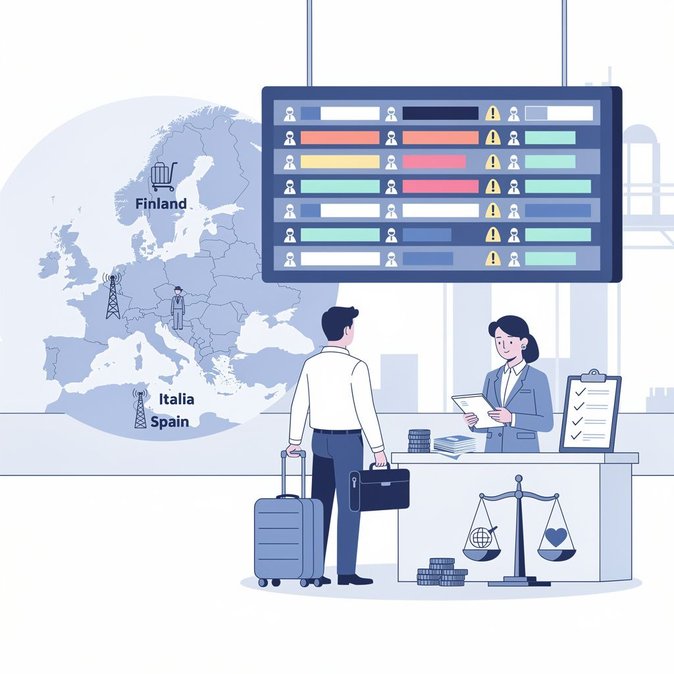
As Europe heads into another strike-laden summer, Finnish companies with staff on the road should revisit the fine print of EU passenger-rights law. A detailed explainer published on 25 June by Travelers Today breaks down how EU Regulation 261/2004 applies to three separate labour actions converging this week: an Italy-wide ground-handling walkout on 26 June, Ryanair cabin-crew strikes in several countries, and rolling air-traffic-control stoppages in Spain. The key takeaway for Finland-based passengers is that not every strike yields cash compensation. When disruption is caused by airport staff outside the airline’s control—as in the 24-hour Italian handlers strike—carriers owe duty of care (meals, hotels) and a choice of refund or re-routing, but no automatic €250–600 payout.
On a related note, Finnish travel coordinators scrambling to adjust itineraries should remember that visa and entry rules can shift just as quickly as flight schedules. VisaHQ’s Finland portal (https://www.visahq.com/finland/) allows companies to verify destination requirements, file e-visa applications and track approvals in real time, helping travellers avoid last-minute airport surprises amid strike-triggered rebookings.
By contrast, if an airline’s own employees strike—as Ryanair cabin crew plan to do—cash compensation may apply so long as the flight departs an EU airport or the carrier is EU-licensed. Why does this matter to Finnish businesses? Italy is Finland’s eighth-largest leisure destination and a growing source of machinery exports. Finnair alone schedules up to four daily flights to Milan and Rome in summer, while Norwegian and SAS operate seasonal services from Helsinki and Turku. With handlers off the ramps, travellers should expect afternoon cancellations outside Italy’s legally protected windows (07:00-10:00 and 18:00-21:00). Mobility managers should pre-emptively shift meetings, verify that PNRs include corporate contact details, and remind employees to keep receipts for incidental expenses. The article’s step-by-step claim checklist is equally relevant for upcoming Finnair pilot strikes in December. Travellers must document the cause of delay in writing, submit claims first to the airline, and escalate to the national enforcement body—Traficom in Finland—if the carrier fails to respond. Given recent backlogs at airline claims departments, companies may wish to bulk-file via approved recovery services but should note the typical 20–30 percent commission. Bottom line: understanding the difference between ‘extraordinary circumstances’ and airline-controlled strikes can save Finnish organisations thousands of euros in unrecovered costs and ensure travellers receive the care they are entitled to during a volatile summer schedule.
On a related note, Finnish travel coordinators scrambling to adjust itineraries should remember that visa and entry rules can shift just as quickly as flight schedules. VisaHQ’s Finland portal (https://www.visahq.com/finland/) allows companies to verify destination requirements, file e-visa applications and track approvals in real time, helping travellers avoid last-minute airport surprises amid strike-triggered rebookings.
By contrast, if an airline’s own employees strike—as Ryanair cabin crew plan to do—cash compensation may apply so long as the flight departs an EU airport or the carrier is EU-licensed. Why does this matter to Finnish businesses? Italy is Finland’s eighth-largest leisure destination and a growing source of machinery exports. Finnair alone schedules up to four daily flights to Milan and Rome in summer, while Norwegian and SAS operate seasonal services from Helsinki and Turku. With handlers off the ramps, travellers should expect afternoon cancellations outside Italy’s legally protected windows (07:00-10:00 and 18:00-21:00). Mobility managers should pre-emptively shift meetings, verify that PNRs include corporate contact details, and remind employees to keep receipts for incidental expenses. The article’s step-by-step claim checklist is equally relevant for upcoming Finnair pilot strikes in December. Travellers must document the cause of delay in writing, submit claims first to the airline, and escalate to the national enforcement body—Traficom in Finland—if the carrier fails to respond. Given recent backlogs at airline claims departments, companies may wish to bulk-file via approved recovery services but should note the typical 20–30 percent commission. Bottom line: understanding the difference between ‘extraordinary circumstances’ and airline-controlled strikes can save Finnish organisations thousands of euros in unrecovered costs and ensure travellers receive the care they are entitled to during a volatile summer schedule.