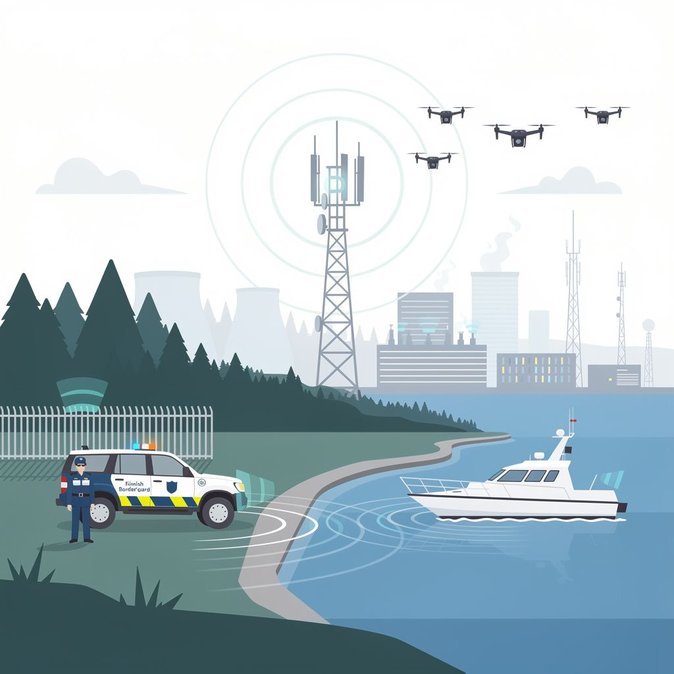
The Finnish Border Guard has moved quickly to close a growing security gap: the rising use of small, inexpensive drones along Finland’s 1,340-kilometre land and maritime border with Russia. On 25 June 2026 the agency unveiled an industrial consortium—headed by Finnish tech giant Nokia—tasked with developing a nationwide counter-unmanned-aircraft (C-UAS) capability for patrol vehicles, coastal vessels and fixed border posts. Nokia Defense will supply a secure 4G/5G and edge-cloud network that stitches together radar, radio-frequency sensors and electro-optical cameras, allowing operators to detect, track and, where authorised, disable hostile drones in real time. Finland’s eastern frontier has been under exceptional pressure since late 2023, when Helsinki closed all nine road crossings after a sudden spike in irregular migration routed through Russia. While the border remains shut to most civilian traffic, the authorities have seen a sharp increase in drone incursions—some for smuggling, others for reconnaissance. The new system is designed to give border units, customs officers and coastal patrols a shared situational picture, reducing response times from “minutes to seconds”, according to the Border Guard’s project lead, Commander Juha Ranne. Under the programme, prototype sensor suites will be installed on SISU GTP armoured vehicles and on Coast Guard patrol boats in 2027, with a procurement decision on a fleet-wide roll-out expected in 2028. Because the architecture is software-defined, it can integrate future effectors such as directed-energy jammers or drone-capture nets without major hardware changes. The Ministry of the Interior has earmarked an initial €44 million from the 2026 supplementary budget, and officials say additional EU border-security funds are being pursued. For multinational firms operating logistics hubs, data centres or wind farms near Finland’s eastern border, the project promises a more predictable risk environment. Nokia says private-sector sites will be able to “plug in” to the secure network on a subscription basis—mirroring models already used for police and emergency-services broadband. Employers should begin mapping critical sites and liaising with local border districts to ensure assets are covered once the network goes live. Practically, business travellers and expat families are unlikely to notice day-to-day changes, but companies moving sensitive goods (medical isotopes, pharmaceuticals, defence components) will gain an additional line of protection. Corporate security managers should track the pilot deployments in 2027 and update travel-risk assessments, particularly for staff transiting the ports of Vaalimaa, Nuijamaa and the eastern Gulf of Finland where the first maritime nodes will be tested.
Source: MarketScreener (press release)