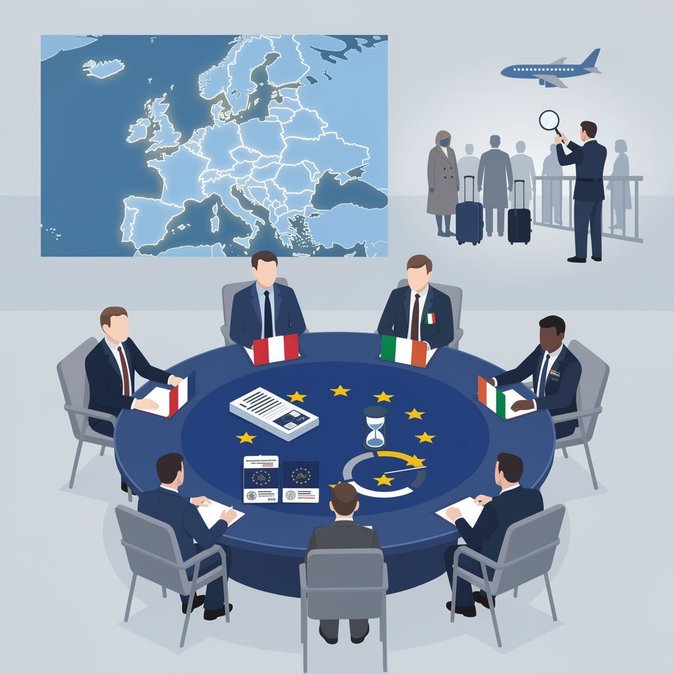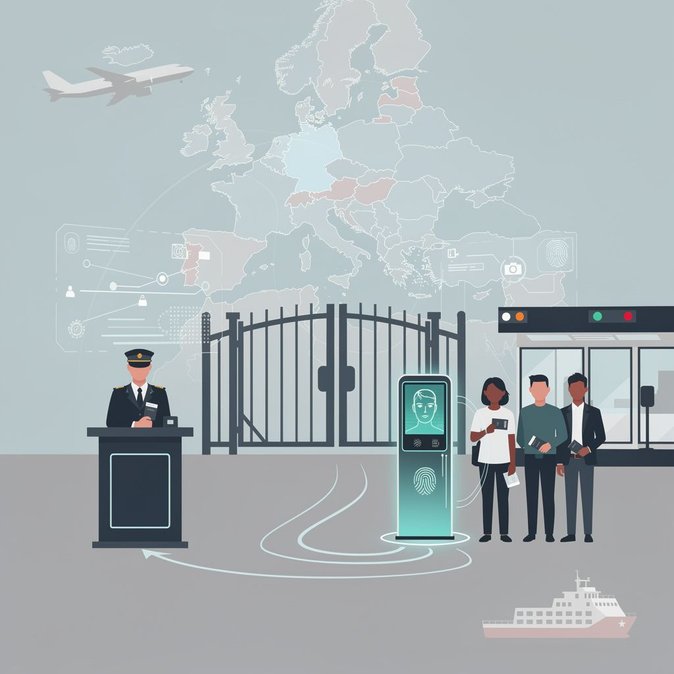
At a joint virtual press conference on 26 June, interior ministers from France, Italy, Germany, the Netherlands and Belgium unveiled what they called a “second-generation border package” designed to close remaining gaps before the mandatory launch of the EU Entry/Exit System (EES) on 10 April 2026 and the ETIAS travel authorisation later that year. France’s Gérald Darmanin confirmed that the country will pilot a new artificial-intelligence module that cross-references ETIAS applications with international watch-lists, airline PNR data and social-media risk indicators. The algorithm—developed by French start-up Synapse and already tested at Roissy-Charles-de-Gaulle’s Terminal 2E—assigns a colour-coded risk score that determines whether an application is approved in real time, diverted to manual processing or refused outright. The partners also agreed to a common Schengen-wide ‘trusted carrier’ scheme: airlines and coach operators that integrate biometric kiosks at departure gates will be able to fast-track low-risk passengers and avoid carrier-liability fines. Air France said it will deploy 60 additional kiosks at Orly and Lyon by February, and Eurostar plans similar facilities at Paris Gare du Nord. While the announcement does not change the ETIAS fee (€20) or core requirements, it has significant operational implications for corporate mobility programmes. French-based multinationals were advised to upload workforce passport data to the forthcoming “ETIAS Business Gateway” to minimise false positives once the system opens for registration—provisionally on 15 November 2026. The ministers stressed that data protection safeguards are in place, with France’s CNIL supervising algorithmic auditing. Travel-risk specialists welcomed the harmonisation but cautioned that during the first weeks of EES, third-country nationals—including UK passport holders—should expect longer wait times at French ports, particularly Dover-Calais and St-Pancras where exit booths are being rebuilt. Companies are urged to factor an extra 45–60 minutes into itineraries for land crossings and to brief travellers on fingerprint and facial-capture procedures.
Source: Travel and Tour World