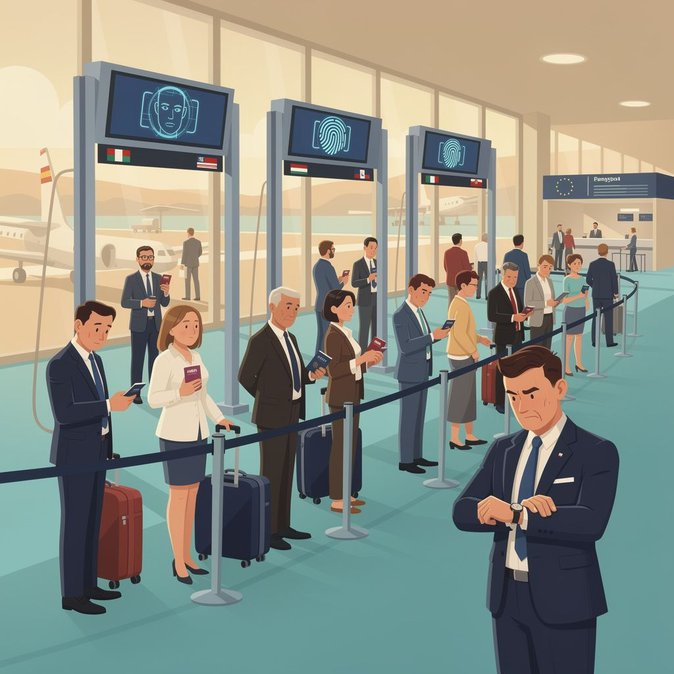
On the heels of Italy’s broader concerns about the EU Entry/Exit System, national daily Quotidiano Nazionale reported fresh scenes of passenger gridlock at Rome-Fiumicino on 26 June 2026. Aeroporti di Roma executives told the paper that biometric kiosks are now the airport’s single biggest capacity constraint and urged Brussels to authorise time-limited suspensions during exceptional surges.
Since EES captures all first-time biometric data on non-EU travellers, even experienced flyers can be forced back into full enrolment when kiosks mis-read fingerprints or facial images, effectively doubling processing time. Airport sources claim that throughput has fallen from a pre-EES 220 passengers per hour per booth to just 100 at peak. The European Commission retorted that most delays are due to staffing shortages rather than the system itself and noted that Italy can already invoke flexibility clauses if national authorities deem it necessary. ADR counters that legal liability remains unclear and that a coordinated EU communication plan is essential to avoid passenger confusion should countries begin applying exemptions unilaterally.
Travellers looking to minimise stress before arrival can turn to VisaHQ, which keeps a constantly updated overview of Italy’s evolving entry rules and EES procedures at https://www.visahq.com/italy/ The service walks users through visa, passport, and biometric requirements step by step and can even arrange courier handling, giving passengers one less thing to worry about while authorities debate system fixes.
For corporate travel managers the debate spells uncertainty. Some are now advising travellers to route via airports such as Zurich, which—while still subject to EES—report smoother first-time enrolment. Others are considering VIP fast-track services that include escorted passage through manual counters still permitted under EU law.
Negotiations between the Italian Transport Ministry and the Commission are expected next week. A temporary protocol could emerge that lets airports throttle biometric capture once real-time queues exceed a yet-to-be-defined threshold, offering at least partial relief ahead of August’s traditional holiday peak.
Since EES captures all first-time biometric data on non-EU travellers, even experienced flyers can be forced back into full enrolment when kiosks mis-read fingerprints or facial images, effectively doubling processing time. Airport sources claim that throughput has fallen from a pre-EES 220 passengers per hour per booth to just 100 at peak. The European Commission retorted that most delays are due to staffing shortages rather than the system itself and noted that Italy can already invoke flexibility clauses if national authorities deem it necessary. ADR counters that legal liability remains unclear and that a coordinated EU communication plan is essential to avoid passenger confusion should countries begin applying exemptions unilaterally.
Travellers looking to minimise stress before arrival can turn to VisaHQ, which keeps a constantly updated overview of Italy’s evolving entry rules and EES procedures at https://www.visahq.com/italy/ The service walks users through visa, passport, and biometric requirements step by step and can even arrange courier handling, giving passengers one less thing to worry about while authorities debate system fixes.
For corporate travel managers the debate spells uncertainty. Some are now advising travellers to route via airports such as Zurich, which—while still subject to EES—report smoother first-time enrolment. Others are considering VIP fast-track services that include escorted passage through manual counters still permitted under EU law.
Negotiations between the Italian Transport Ministry and the Commission are expected next week. A temporary protocol could emerge that lets airports throttle biometric capture once real-time queues exceed a yet-to-be-defined threshold, offering at least partial relief ahead of August’s traditional holiday peak.