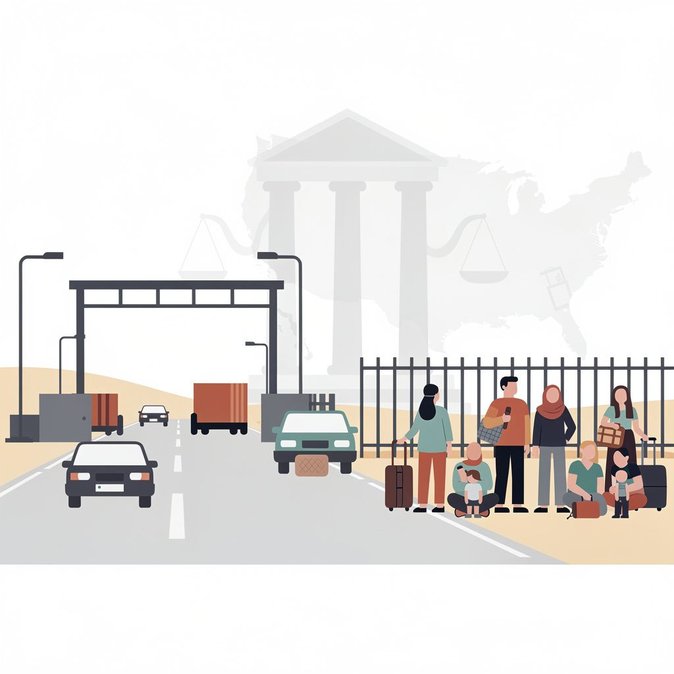
Just one day after the TPS decision, the Supreme Court issued a separate 6-3 ruling allowing U.S. Customs and Border Protection (CBP) officers to block asylum seekers from physically entering the United States when ports of entry are deemed “operationally over capacity.” The practice—called metering or “turn-back”—was suspended in 2022 but can now resume immediately. Under the ruling, migrants who arrive at border bridges or checkpoints may be instructed to take a number and wait in Mexico, sometimes for weeks, before they are even permitted to begin the asylum process. The Court’s majority found that nothing in the Immigration and Nationality Act guarantees an immediate right to present oneself on U.S. soil, and it emphasized deference to executive border-management decisions made “in the national interest.” For multinational companies that rotate staff through Mexican maquiladora facilities or employ cross-border commuters, the decision raises concerns about traffic slow-downs and humanitarian bottlenecks that can spill over into commercial lanes. Human-resource teams should monitor CBP port-status alerts and advise traveling employees to carry evidence of legal status—such as SENTRI cards or work visas—because advocacy groups warn that chaotic queues could increase secondary screening of all travelers. From a compliance perspective, U.S. corporations must ensure that any humanitarian assistance they provide to stranded migrants—food drives, medical tents, legal clinics—conforms to federal anti-harboring statutes. Several Fortune 500 companies have already issued statements urging Congress to create additional processing capacity rather than rely on metering, which they argue damages the United States’ reputation for due-process fairness and complicates cross-border trade valued at nearly $800 billion annually. Immigration attorneys anticipate a spike in Mexican and Central American nationals attempting to schedule CBP One smartphone-app appointments, a system that was already booking out weeks in advance. Logistics experts recommend that shippers expect intermittent delays at San Ysidro, El Paso and Laredo as CBP reallocates officers to manage pedestrian backlogs created by the turn-back policy’s re-implementation.
Source: Democracy Now!