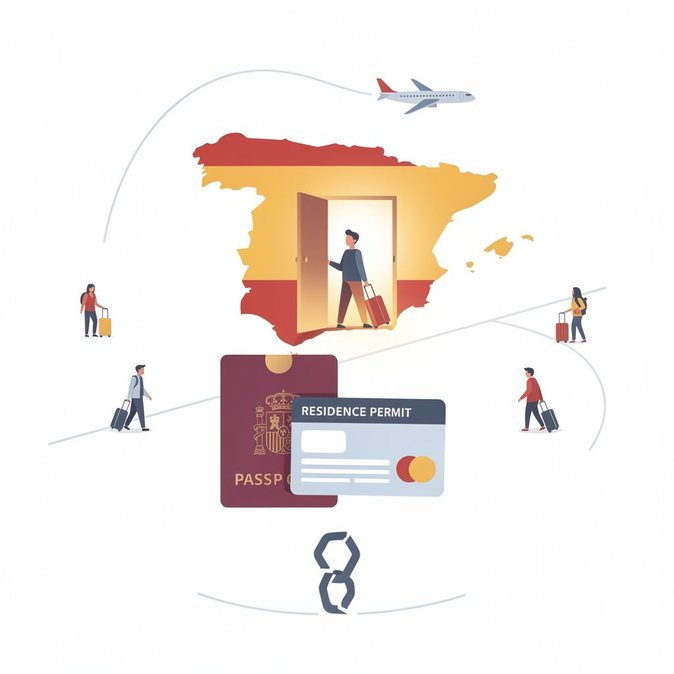
Spain’s Council of Ministers has formally opened an extraordinary regularisation programme that could transform the legal status of hundreds of thousands of people who have been living and working in Spain without papers. Approved earlier this spring but published in the Boletín Oficial del Estado on 27 June 2026, the measure allows foreign nationals who can prove continuous residence in Spain before 1 January 2026 and the absence of a criminal record to obtain a one-year residence-and-work authorisation that can later be converted into the standard regimen.
If you are planning to benefit from the new programme—or need assistance with any other Spanish immigration matter—VisaHQ can help streamline the process. Their Spain portal (https://www.visahq.com/spain/) offers clear checklists, document-preparation tools, and expert guidance, making it easier for both individuals and employers to compile the right evidence, book appointments, and stay fully compliant.
The Jesuit Migrant Service (Servicio Jesuita a Migrantes – SJM) and other civil-society organisations welcomed the move, calling it “a long-overdue response to social reality.” Employers’ groups also praised the decision, noting acute labour shortages in hospitality, agriculture and elder-care that cannot be filled locally. By bringing irregular workers into the formal system, companies gain legal certainty, while the government expects a boost in Social-Security contributions at a time when Spain’s pension costs are rising sharply. From a compliance perspective the programme is remarkably streamlined. Applicants submit proof of identity, empirical evidence of residency (school enrolment, rental contracts, bank statements, etc.) and a clean-record certificate from their country of origin. No job offer is required at the time of filing; instead, beneficiaries have twelve months to register with Social Security and sign an employment contract or set up a legal business. Immigration lawyers report that appointments are being allotted online within days, a stark contrast to the year-long waits that plagued Spain’s offices in the past. For multinational employers the implications are significant. Employees whose status is regularised will be able to travel for business within the Schengen Area, obtain an EU Blue Card in the future, and enrol in company benefit schemes that demand proof of lawful residence. HR teams that have been silently accommodating shadow-workforce realities now have a pathway to full compliance. Observers note, however, that the window is short. The application portal will close on 30 June 2026, and the Interior Ministry has not committed to any extension. Companies with large numbers of subcontracted or temporary staff are therefore racing to help eligible workers gather documentation before the deadline. Failure to act could mean losing key talent once intensified labour-inspectorate sweeps begin later this year.
If you are planning to benefit from the new programme—or need assistance with any other Spanish immigration matter—VisaHQ can help streamline the process. Their Spain portal (https://www.visahq.com/spain/) offers clear checklists, document-preparation tools, and expert guidance, making it easier for both individuals and employers to compile the right evidence, book appointments, and stay fully compliant.
The Jesuit Migrant Service (Servicio Jesuita a Migrantes – SJM) and other civil-society organisations welcomed the move, calling it “a long-overdue response to social reality.” Employers’ groups also praised the decision, noting acute labour shortages in hospitality, agriculture and elder-care that cannot be filled locally. By bringing irregular workers into the formal system, companies gain legal certainty, while the government expects a boost in Social-Security contributions at a time when Spain’s pension costs are rising sharply. From a compliance perspective the programme is remarkably streamlined. Applicants submit proof of identity, empirical evidence of residency (school enrolment, rental contracts, bank statements, etc.) and a clean-record certificate from their country of origin. No job offer is required at the time of filing; instead, beneficiaries have twelve months to register with Social Security and sign an employment contract or set up a legal business. Immigration lawyers report that appointments are being allotted online within days, a stark contrast to the year-long waits that plagued Spain’s offices in the past. For multinational employers the implications are significant. Employees whose status is regularised will be able to travel for business within the Schengen Area, obtain an EU Blue Card in the future, and enrol in company benefit schemes that demand proof of lawful residence. HR teams that have been silently accommodating shadow-workforce realities now have a pathway to full compliance. Observers note, however, that the window is short. The application portal will close on 30 June 2026, and the Interior Ministry has not committed to any extension. Companies with large numbers of subcontracted or temporary staff are therefore racing to help eligible workers gather documentation before the deadline. Failure to act could mean losing key talent once intensified labour-inspectorate sweeps begin later this year.