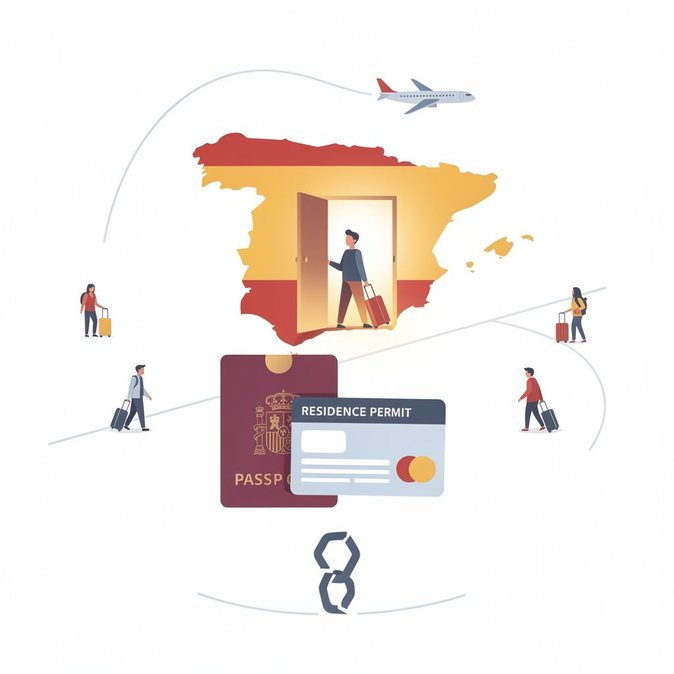
In a landmark shift for globally mobile professionals, Spain has abolished the so-called “183-day rule” that automatically cancelled temporary residence permits when holders spent more than six consecutive months outside the country. The change, confirmed by a 27 June 2026 update to the Supreme Court ruling published in the BOE, applies to roughly 1.5 million non-EU nationals on student, digital-nomad, family-reunification and other temporary visas. The Supreme Court held that the automatic revocation violated the constitutional right to free movement because the underlying regulation lacked a proportionality test.
Amid these developments, travelers and HR managers may find it helpful to consult VisaHQ, an online visa and passport facilitation platform whose Spain portal (https://www.visahq.com/spain/) tracks the latest immigration updates. VisaHQ can help individuals and corporations prepare or renew Spanish permits, book appointments, and gather required documentation, offering a streamlined path to compliance under the new rules.
Immigration offices must now evaluate absence cases individually and cannot deny renewals solely on time spent abroad. Holders whose cards were cancelled in previous years may file for reinstatement by presenting evidence of continued ties to Spain. For multinationals the practical effect is immediate. Employees assigned to Spain can now accept extended overseas projects or home-country rotations without risking loss of status, provided they keep meeting standard renewal criteria (income, insurance, clear criminal record). Travel managers anticipate a sharp drop in emergency flight bookings triggered by looming six-month cut-off dates. Although the ruling removes a major pain-point, lawyers caution that absences still count toward the ten-month limit in the first five-year period used to qualify for permanent residency. Companies should therefore track travel days for long-term planning even if short-term compliance pressure eases. No extra paperwork or fees are required; the change is self-executing. However, HR departments should update internal mobility policies and instruct payroll vendors not to suspend tax-equalisation benefits when an employee exceeds 183 days abroad during a temporary assignment, as residence now remains intact.
Amid these developments, travelers and HR managers may find it helpful to consult VisaHQ, an online visa and passport facilitation platform whose Spain portal (https://www.visahq.com/spain/) tracks the latest immigration updates. VisaHQ can help individuals and corporations prepare or renew Spanish permits, book appointments, and gather required documentation, offering a streamlined path to compliance under the new rules.
Immigration offices must now evaluate absence cases individually and cannot deny renewals solely on time spent abroad. Holders whose cards were cancelled in previous years may file for reinstatement by presenting evidence of continued ties to Spain. For multinationals the practical effect is immediate. Employees assigned to Spain can now accept extended overseas projects or home-country rotations without risking loss of status, provided they keep meeting standard renewal criteria (income, insurance, clear criminal record). Travel managers anticipate a sharp drop in emergency flight bookings triggered by looming six-month cut-off dates. Although the ruling removes a major pain-point, lawyers caution that absences still count toward the ten-month limit in the first five-year period used to qualify for permanent residency. Companies should therefore track travel days for long-term planning even if short-term compliance pressure eases. No extra paperwork or fees are required; the change is self-executing. However, HR departments should update internal mobility policies and instruct payroll vendors not to suspend tax-equalisation benefits when an employee exceeds 183 days abroad during a temporary assignment, as residence now remains intact.