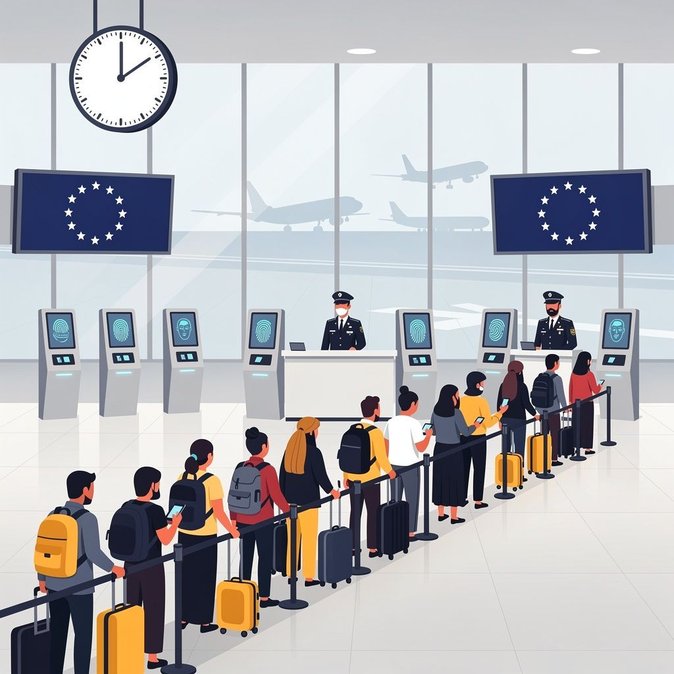
Just three months after Spain and its Schengen partners switched off manual passport stamping, the new biometric Entry/Exit System (EES) is facing its sternest test: the summer peak. A 27 June travel advisory from independent intelligence outlet Deep Arrival warns of wait times of up to six hours at major hubs across Europe, including Madrid-Barajas and Barcelona El Prat, as non-EU passengers queue for the mandatory first-time facial-and-fingerprint enrolment. Spanish airport authority Aena has deployed extra National Police officers and reopened some manned booths, but airlines report missed connections and tight turn-arounds—particularly on trans-Atlantic arrivals that bank multiple wide-body flights within short time-frames. Aviation sources say Barajas’ Terminal 4S is experiencing average immigration processing of 45–90 minutes for US and Latin-American nationals, well above the pre-EES norm of 15–25 minutes. The delays are fuelling calls from industry bodies to introduce a phased implementation or additional self-service kiosks. Rome Fiumicino has already threatened to suspend the system during critical peaks; Spanish carriers fear similar measures could fragment border-control procedures and create passenger-confusion risks. The International Air Transport Association (IATA) estimates that adding just two minutes to each passenger transaction at a 30-flight afternoon wave forces airlines to re-book or delay up to 1,800 travellers. For companies routing staff through Spain this summer, mobility managers should adopt a “three-hour rule” for international connections, advise travellers to download airport apps that show real-time queue times, and ensure travel insurance covers missed-flight costs linked to border formalities. Long-stay assignees arriving on national visas (including Spain’s Digital Nomad Visa) should retain paper copies of visa approval letters in case e-gates divert them to staffed counters. Looking ahead, the European Commission insists EES teething problems will ease once the majority of frequent travellers are enrolled and as ETIAS—Europe’s electronic travel authorisation—comes online in late 2026. In the meantime, Spanish airports are fast-tracking the installation of additional biometric kiosks and negotiating temporary staffing uplifts with the Interior Ministry to protect throughput during July and August.
Source: Deep Arrival