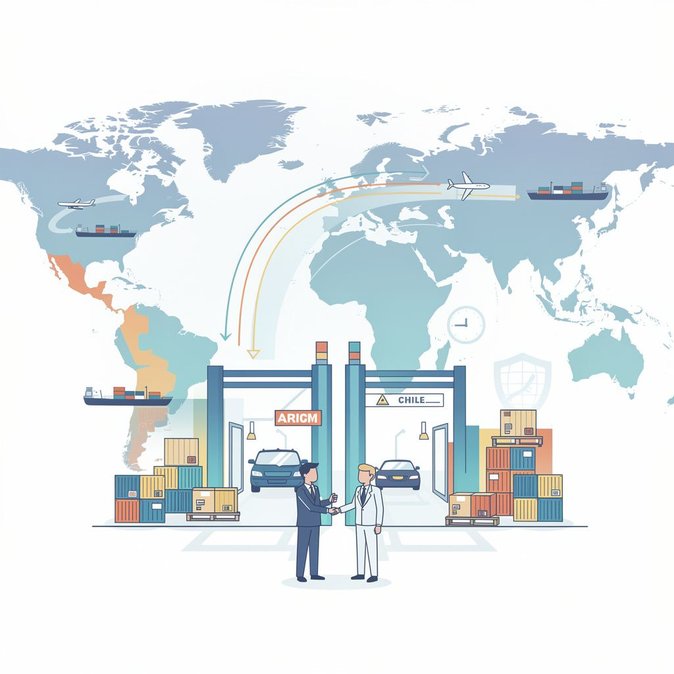
Hong Kong Customs has added South America to its fast-growing network of Authorised Economic Operator (AEO) partners, signing a Mutual Recognition Arrangement (MRA) with the National Customs Service of Chile on 26 June during the World Customs Organization’s annual council meetings in Brussels.
For businesses and trade professionals who may need to move staff between Hong Kong and Latin-American markets as these new arrangements take effect, VisaHQ can simplify the visa and travel-document process. The company’s Hong Kong portal (https://www.visahq.com/hong-kong/) provides up-to-date requirements, online applications and concierge support for work, business and transit visas—helping exporters, freight forwarders and compliance teams stay focused on supply-chain opportunities rather than paperwork.
Commissioner of Customs and Excise Chan Tsz-tat inked the agreement with his Chilean counterpart Alejandra Arriaza Loeb, enabling trusted traders in both economies to enjoy lower inspection rates, priority handling and dedicated service windows at the border. The deal is the 15th bilateral MRA concluded under Hong Kong’s AEO programme since it was launched in 2012. It follows similar pacts with Peru (December 2025) and the United Arab Emirates (October 2025), and marks Hong Kong’s first customs accord with a Pacific-Alliance member. For multinational companies routing Latin-American cargo through Hong Kong’s port and airport hubs, the recognition eliminates duplicate compliance checks and can shave up to 24 hours off door-to-door transit times. Chan said the arrangement “sends a strong signal that Hong Kong remains an indispensable gateway between mainland China and the Americas”. Logistics providers estimate that AEO consignments account for roughly 30 percent of the SAR’s US$650 billion yearly trade, and that every one-percentage-point rise adds about HK$5 billion (US$640 million) to re-export value. Beyond the headline agreement, Hong Kong Customs also signed an MRA Action Plan with Brazil and was re-elected vice-chair of the WCO’s Asia-Pacific region (2026-28). Those roles give the city extra influence over forthcoming standards on data exchange and green-lane pilots—topics closely watched by regional supply-chain managers. Practical tip: Companies already accredited as Hong Kong AEOs do not need to file new paperwork; benefits in Chile will be automatic once the arrangement enters force (expected Q4 2026). Firms that are not yet certified should budget three to six months for the on-site validation process and consider beginning now to capture early-mover advantages when other Latin-American MRAs follow.
For businesses and trade professionals who may need to move staff between Hong Kong and Latin-American markets as these new arrangements take effect, VisaHQ can simplify the visa and travel-document process. The company’s Hong Kong portal (https://www.visahq.com/hong-kong/) provides up-to-date requirements, online applications and concierge support for work, business and transit visas—helping exporters, freight forwarders and compliance teams stay focused on supply-chain opportunities rather than paperwork.
Commissioner of Customs and Excise Chan Tsz-tat inked the agreement with his Chilean counterpart Alejandra Arriaza Loeb, enabling trusted traders in both economies to enjoy lower inspection rates, priority handling and dedicated service windows at the border. The deal is the 15th bilateral MRA concluded under Hong Kong’s AEO programme since it was launched in 2012. It follows similar pacts with Peru (December 2025) and the United Arab Emirates (October 2025), and marks Hong Kong’s first customs accord with a Pacific-Alliance member. For multinational companies routing Latin-American cargo through Hong Kong’s port and airport hubs, the recognition eliminates duplicate compliance checks and can shave up to 24 hours off door-to-door transit times. Chan said the arrangement “sends a strong signal that Hong Kong remains an indispensable gateway between mainland China and the Americas”. Logistics providers estimate that AEO consignments account for roughly 30 percent of the SAR’s US$650 billion yearly trade, and that every one-percentage-point rise adds about HK$5 billion (US$640 million) to re-export value. Beyond the headline agreement, Hong Kong Customs also signed an MRA Action Plan with Brazil and was re-elected vice-chair of the WCO’s Asia-Pacific region (2026-28). Those roles give the city extra influence over forthcoming standards on data exchange and green-lane pilots—topics closely watched by regional supply-chain managers. Practical tip: Companies already accredited as Hong Kong AEOs do not need to file new paperwork; benefits in Chile will be automatic once the arrangement enters force (expected Q4 2026). Firms that are not yet certified should budget three to six months for the on-site validation process and consider beginning now to capture early-mover advantages when other Latin-American MRAs follow.