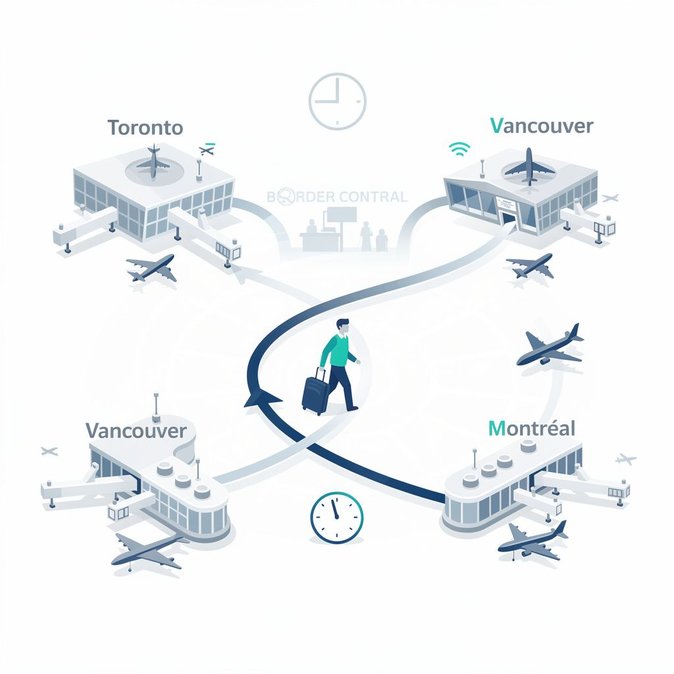
The Canada Border Services Agency (CBSA) has quietly switched on its new “Free Flow International-to-International Transit” program, allowing most connecting international passengers at Toronto Pearson (Terminal 1), Vancouver International (YVR) and Montréal-Trudeau (YUL) to move directly to their onward gates without clearing Canadian border control. Travellers with a confirmed same-day onward ticket and through-checked baggage are now redirected to a sterile international departures zone, saving 30-60 minutes compared with the previous kiosk-based in-transit process.
The change, effective June 29, 2026, replaces the 2018 pilot that required passengers to scan passports at dedicated kiosks. Airlines now transmit passenger and itinerary data electronically to CBSA, which performs advance risk screening behind the scenes—similar to the Advance Passenger Information/Passenger Name Record (API-PNR) model used at major U.S. hubs.
CBSA Vice-President Rob Chambers said the objective is to “provide a simpler and more efficient process for travellers to get to their international destinations without delay.”
Business travellers stand to benefit the most. According to the Canadian Global Mobility Association, roughly 18 percent of corporate trips routed through Canada involve same-calendar-day onward flights to the United States, Latin America, or Europe. The Free Flow corridor eliminates an unpredictable chokepoint that often forced companies to buy fully flexible fares or overnight layovers in case of missed connections.
If your team needs help confirming whether a Canadian transit visa or eTA is required before taking advantage of the new Free Flow corridor, VisaHQ can simplify the process. Their online platform (https://www.visahq.com/canada/) provides real-time visa information, digital document kits, and concierge filing services, ensuring travelers secure the right authorization quickly and avoid last-minute surprises.
Airports outside the big three can apply to join the scheme. Calgary, Edmonton and Halifax have already signalled interest, but CBSA officials cautioned that adoption requires significant IT integration and secure-zone modifications.
CBSA also stressed that the exemption ends if a traveller’s lay-over exceeds 24 hours, baggage is not interlined, or the passenger leaves the sterile area—situations that would trigger full border processing.
For global mobility managers, the takeaway is clear: routings through YYZ, YVR or YUL have gained new appeal for tight connection itineraries. Visa rules remain unchanged—transit visa or eTA requirements still apply—but employees can confidently book shorter lay-overs knowing the odds of missing meetings due to a bottleneck at primary inspection are dramatically lower.
The change, effective June 29, 2026, replaces the 2018 pilot that required passengers to scan passports at dedicated kiosks. Airlines now transmit passenger and itinerary data electronically to CBSA, which performs advance risk screening behind the scenes—similar to the Advance Passenger Information/Passenger Name Record (API-PNR) model used at major U.S. hubs.
CBSA Vice-President Rob Chambers said the objective is to “provide a simpler and more efficient process for travellers to get to their international destinations without delay.”
Business travellers stand to benefit the most. According to the Canadian Global Mobility Association, roughly 18 percent of corporate trips routed through Canada involve same-calendar-day onward flights to the United States, Latin America, or Europe. The Free Flow corridor eliminates an unpredictable chokepoint that often forced companies to buy fully flexible fares or overnight layovers in case of missed connections.
If your team needs help confirming whether a Canadian transit visa or eTA is required before taking advantage of the new Free Flow corridor, VisaHQ can simplify the process. Their online platform (https://www.visahq.com/canada/) provides real-time visa information, digital document kits, and concierge filing services, ensuring travelers secure the right authorization quickly and avoid last-minute surprises.
Airports outside the big three can apply to join the scheme. Calgary, Edmonton and Halifax have already signalled interest, but CBSA officials cautioned that adoption requires significant IT integration and secure-zone modifications.
CBSA also stressed that the exemption ends if a traveller’s lay-over exceeds 24 hours, baggage is not interlined, or the passenger leaves the sterile area—situations that would trigger full border processing.
For global mobility managers, the takeaway is clear: routings through YYZ, YVR or YUL have gained new appeal for tight connection itineraries. Visa rules remain unchanged—transit visa or eTA requirements still apply—but employees can confidently book shorter lay-overs knowing the odds of missing meetings due to a bottleneck at primary inspection are dramatically lower.