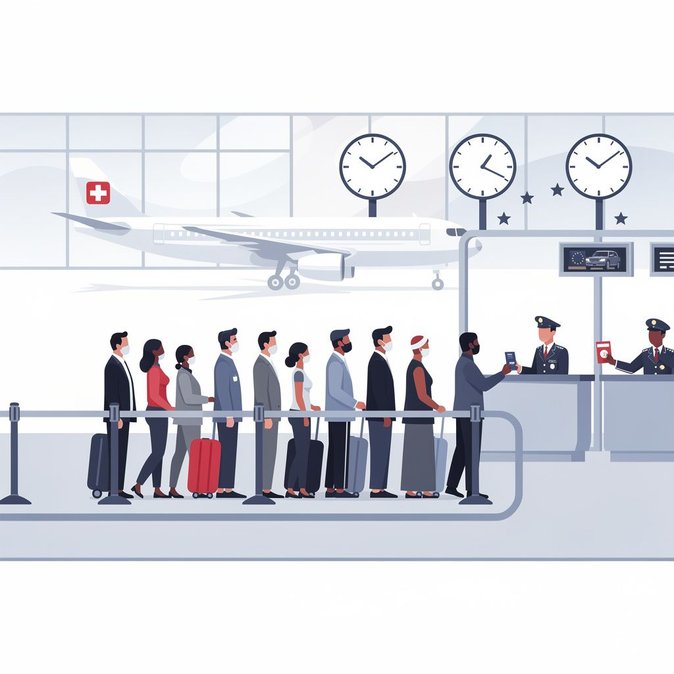
Airlines operating at Switzerland’s two international hubs warn that the new EU Entry/Exit System (EES) could overwhelm passport-control capacity just as the summer rush begins. In a letter seen by the Financial Times and reported on 30 June, the lobby group Airlines for Europe (A4E) said that initial EES checks are taking up to four times longer than the traditional stamp-and-go procedures they replace. Swiss airports—although inside the Schengen area—serve as external borders for the many long-haul flights that originate outside Europe. Zurich and Geneva therefore must apply the full biometric procedure to every third-country traveler, recording finger-prints, facial images and the precise time of entry. EES went live in October 2025 and became mandatory at all Schengen external borders in April 2026. While the technology promises to automate overstayer detection, it is exposing yawning staffing gaps at national border-guard units. According to A4E, the problem is not the software itself but the lack of trained officers and functioning kiosks, especially during peak departure banks. The group has asked the European Commission to let airports temporarily suspend EES when queues exceed two hours, mirroring a precedent used during winter ski traffic at Geneva earlier this year. For Switzerland the stakes are high. Zurich Airport expects more than 90,000 daily passengers in July and August, with roughly 35 % arriving from non-Schengen points such as New York, Dubai and Singapore. Geneva, the main gateway for the western Alps and international organisations, projects record traffic on Fridays and Sundays. Both hubs already struggle to stay within night-curfew limits when late-evening long-haul flights bunch up. Extra minutes per passenger could cascade into missed connections, aircraft curfews and costly diversions. Swiss International Air Lines, the national carrier, has quietly trimmed its evening bank to create more padding. Corporate mobility managers should prepare travellers for extended arrivals and departures. Advisories now recommend allowing at least three hours between scheduled landing and onward rail connections from Zurich HB, and four hours for inter-Schengen transfers at Geneva. Multinational employers are also being told to adjust door-to-door travel policies, reimbursing additional lounge access, duty-time allowances and overnight costs if employees miss last-mile trains. Remote biometric pre-enrolment—once planned for the 2024 rollout—remains unavailable, so travellers must complete capture on arrival until further notice. In the longer term, Switzerland will integrate its national EES interface with the EU’s central database via the Visa Information System upgrade approved by the Federal Council in May. That back-end work should let the airports open more automated e-gates by 2027, but the 2026 summer season will proceed under manual-kiosk constraints. Until then, a combination of early arrival, mobile-check-in and traveller patience may be the only realistic mitigations.
Source: Berliner Zeitung