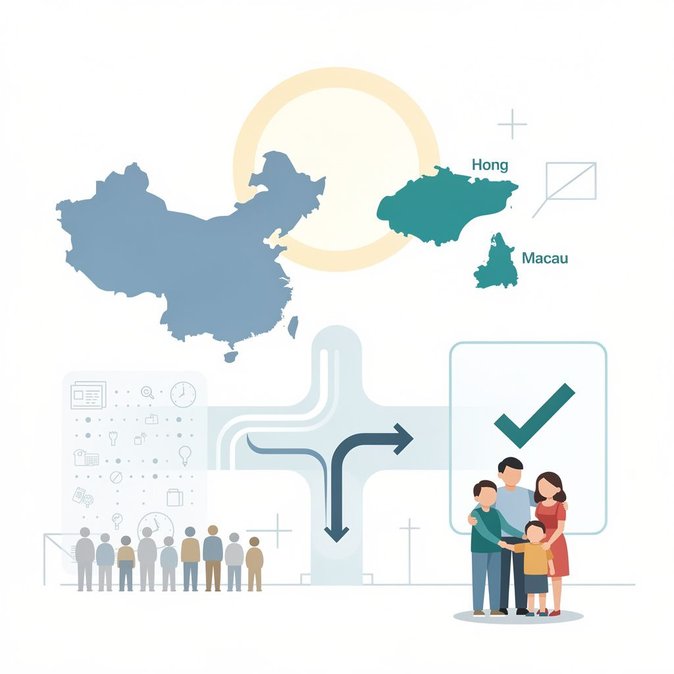
In the most significant change to cross-border migration in more than a decade, the National Immigration Administration (NIA) in Beijing has scrapped its opaque, points-based assessment for the coveted one-way permit and replaced it with four clearly defined family-reunion categories that will take effect on 1 July 2026. Under the new framework, mainland residents will qualify if they (1) have been separated from a Hong Kong or Macau spouse for at least three years; (2) are minors whose parents are both settled in the SARs; (3) are adult children aged 18-59 who need to care for parents already resident in Hong Kong or Macau and aged 60 plus with no other children there; or (4) are parents aged 60 plus with no children on the mainland and an adult child who is a permanent resident in Hong Kong or Macau. Officials say the clearer criteria will replace a quota-driven points system criticised for its lack of transparency and for keeping mixed-location families apart for years. Successful applicants will still receive the one-way permit—Hong Kong processed 51,200 such permits last year—but the NIA will now publish cut-off scores every six months so families can gauge their chances in advance. Immigration lawyers expect processing times to shorten because case officers will have far less discretion to weigh subjective factors such as education or employment history. For Hong Kong employers, the change comes as the city competes with neighbouring Shenzhen for talent and grapples with a shrinking workforce. Simplifying spousal and dependent migration could remove a major deterrent for mainland professionals weighing job offers in Hong Kong, especially in the technology and financial-services sectors clustered in the Northern Metropolis. Human-resources managers are already updating relocation playbooks and advising employees with mainland spouses to gather proof of three-year separation so they can apply on the first day the new rules open. The announcement also carries political overtones. Standardising approval criteria for both Hong Kong and Macau is widely seen as part of Beijing’s push to integrate the two SARs more tightly into the Greater Bay Area, a region of 87 million people earmarked as a single labour and consumer market. While critics worry the policy could accelerate demographic change, Hong Kong officials welcomed the move, saying it will "promote orderly family reunion and social stability." Practically, applicants will file through local Public Security Bureaus on the mainland or dial the NIA’s 12367 hotline for guidance. Employers should note that holders of the one-way permit automatically become Hong Kong permanent residents upon arrival and may work without an additional employment visa—an important distinction when budgeting total cost of hire. Companies are advised to review internal immigration policies immediately and brief affected staff, because the first application window opens tomorrow and early demand is expected to be high.