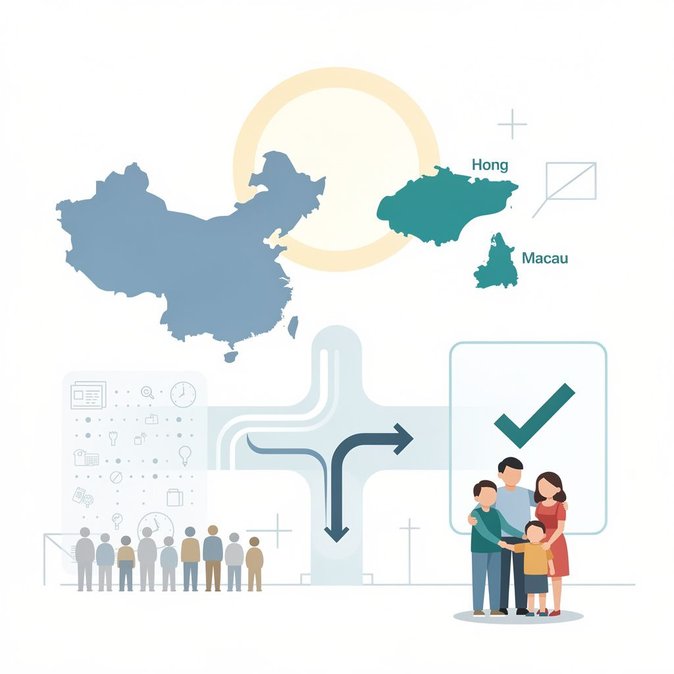
China’s National Immigration Administration (NIA) has issued its most detailed framework yet for approving permanent settlement (“ding-ju”) applications by mainland residents who wish to live in Hong Kong or Macau, ushering in a new, standardised regime that takes effect on 1 July 2026. The circular, numbered 2026-3, collapses dozens of disparate local practices into four nationally-uniform categories. Couples who have lived apart for at least three years may now reunite in either special administrative region (SAR) together with any minor children; minors under 18 may follow both parents who already hold right of abode; adult children aged 18-59 may relocate to care for elderly parents who are over 60 and have no other children in the SARs; and parents over 60 with no children on the mainland may join adult offspring who have already settled in Hong Kong or Macau. Applications will continue to be subject to an annual quota, but public-security bureaus have been instructed to give priority to humanitarian cases and to process files “efficiently and transparently,” according to the notice. For Hong Kong’s corporate mobility managers the clarification matters. Under the old scheme, processing times and documentary requirements varied widely by province, creating uncertainty for mainland staff being rotated into Hong Kong headquarters or regional roles. The new guidance should shorten lead times—industry estimates suggest approvals could fall from 8–12 months to as little as 4–6 months—thereby helping companies plan assignments and family moves with greater confidence. Employers should, however, note the minimum-stay rules: once a residency permit is granted, the holder must enter the SAR within 90 days and cannot be absent for more than 180 days in any 12-month period during the first three years, or the permit may be cancelled. Immigration lawyers also point to knock-on effects for other visa classes. Many mainland professionals currently rely on Hong Kong’s General Employment Policy (GEP) or the Admission Scheme for Mainland Talents & Professionals (ASMTP), which do not automatically confer a path for elderly parents. The clearer family-reunification track could make Hong Kong postings more attractive in sectors such as finance and technology, where firms often struggle to persuade key talent to relocate without family certainty. Finally, the announcement comes just ahead of the HKSAR’s 29th handover anniversary and in the same month that Hong Kong rolled out “seamless e-Channel” automated border gates. Together, the policy moves signal Beijing’s intent to tighten administrative control while also smoothing legitimate flows of people between the mainland and the SARs. Mobility teams should update relocation handbooks immediately, train HR partners on the four categories, and monitor quota utilisation once applications open on 1 July.