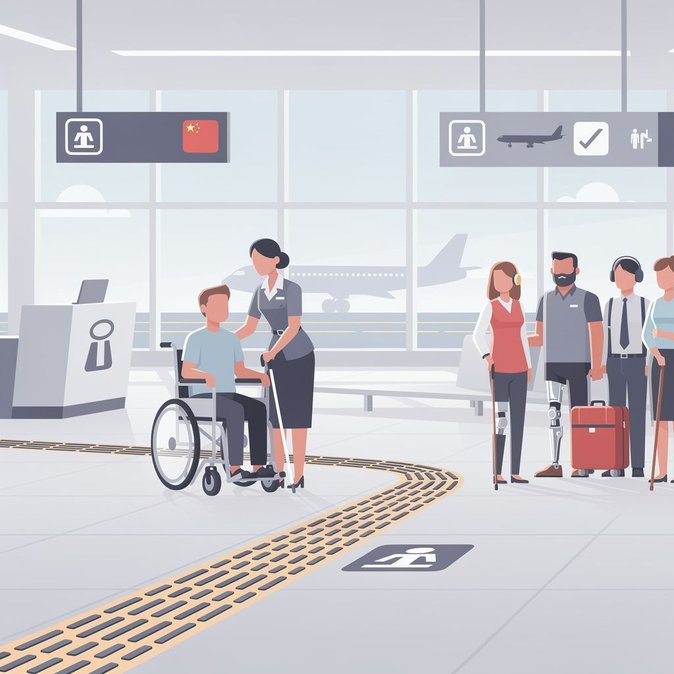
The Civil Aviation Administration of China (CAAC) has released a sweeping directive requiring every mainland airport and airline to provide a fully standardised, door-to-door service chain for passengers with disabilities. Published on 2 July, the measures oblige operators to offer consistent assistance—from curb-side drop-off through check-in, security, boarding and baggage claim to pick-up zones. For the first time, the rules establish a single national benchmark, replacing today’s patchwork of carrier-specific policies. Airports above 10 million passengers a year must, by December, create dedicated service desks, tactile floor paths and audible way-finding systems, while carriers must train cabin crew in mobility-device handling and emergency evacuation for wheelchair users. The new framework also introduces a “closed-loop accountability” model: if any part of the journey fails, the responsible entity is liable for compensation and public disclosure. That is expected to drive infrastructure upgrades—particularly at regional airports chasing transfer traffic from the Yangtze and Pearl River Deltas. For multinational employers, the directive lowers uncertainty when moving staff with limited mobility across China’s vast domestic air network. Travel departments should update internal booking guidelines to flag the requirement to declare assistance needs at least 48 hours before departure so that airports can pre-position equipment. Industry analysts say the move aligns China with ICAO accessibility recommendations and could spur neighbouring ASEAN states to raise their own service standards, creating a more level playing field in intra-Asian business travel.
Source: Xinhua / www.gov.cn