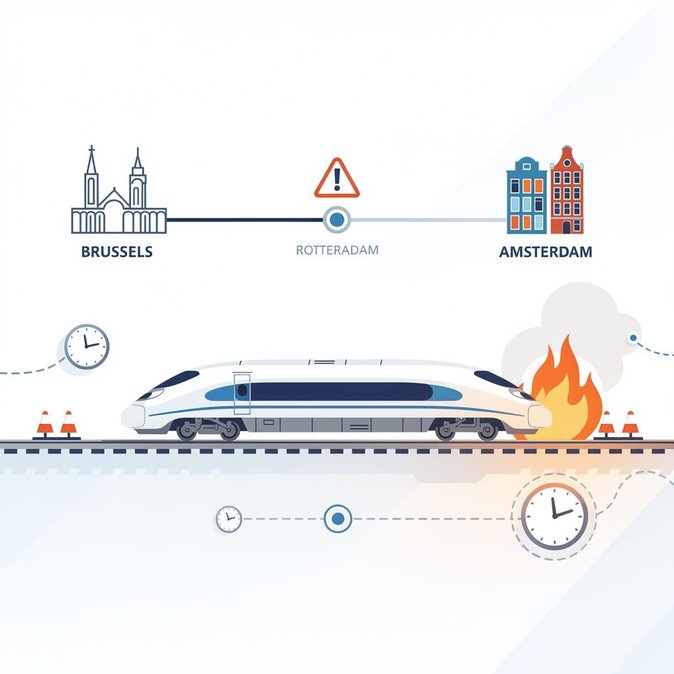
Eurostar passengers travelling between Belgium and the Netherlands are facing another weekend of disruption after a track-side fire near Rotterdam severely damaged signalling cables.
According to Eurostar’s live service bulletin, updated at 18:05 on 4 July 2026, all through-services that normally call at Rotterdam Centraal and Schiphol Airport have been withdrawn until **at least Sunday, 5 July**.
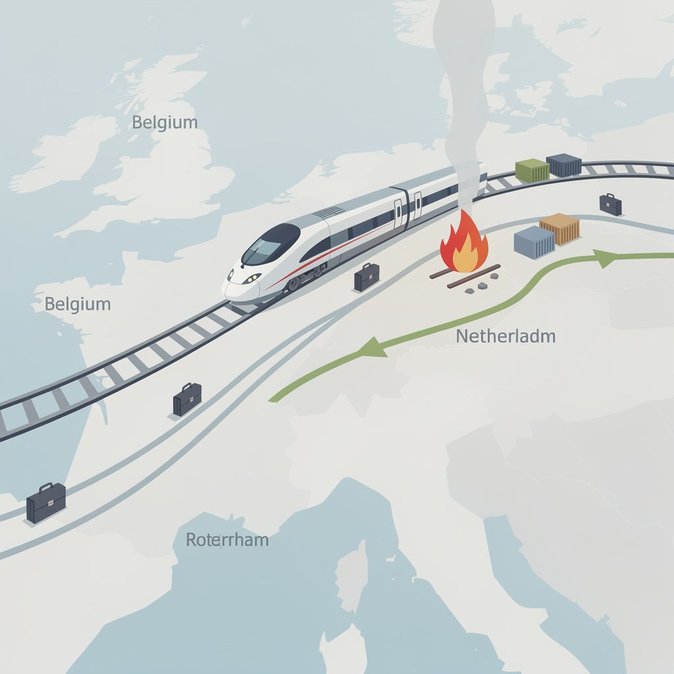
Trains originating in Brussels or Paris are being diverted via an inland freight corridor, adding up to 90 minutes to journeys and sharply reducing seat availability.
Rail infrastructure manager ProRail says temperatures of more than 400 °C warped cabling and overheated concrete sleepers during Thursday night’s blaze.
Engineers must replace 1.3 km of fibre-optic cable and carry out safety testing before normal signals can be restored.
Because only one of the four high-speed tracks remains usable, Eurostar is cancelling selected services (trains 9125, 9143, 9157 and 9167) and operating the remainder with limited capacity.
Business travellers are being urged to “avoid non-essential trips” between Brussels and Amsterdam and instead connect via Thalys or national operator NMBS/SNCB to Antwerp, then IC trains to Breda.
If the disruption forces you to reroute via Belgium or extend your stay, VisaHQ can streamline any last-minute visa or travel-document needs. Their online platform provides fast processing and expert guidance, helping you stay compliant while the rail network recovers.
Eurostar is offering free exchanges or credit vouchers and will refund hotel costs if passengers are forced to overnight in Brussels.
Freight forwarders warn that the diversion is already creating **knock-on delays for time-critical pharma shipments** that rely on the high-speed corridor’s predictable schedules.
The latest setback comes just days after Eurostar restored its full summer timetable following last month’s heat-related speed restrictions.
Combined with the EU’s new Entry/Exit System (EES) checks at Brussels-Midi, travel consultants say journey-time reliability on the core London-Brussels-Amsterdam axis has dropped below 70 % in the past fortnight.
Multinationals are being advised to build in at least a two-hour buffer for Monday-morning meetings in Amsterdam or Brussels until the Rotterdam section is fully repaired.
According to Eurostar’s live service bulletin, updated at 18:05 on 4 July 2026, all through-services that normally call at Rotterdam Centraal and Schiphol Airport have been withdrawn until **at least Sunday, 5 July**.
Trains originating in Brussels or Paris are being diverted via an inland freight corridor, adding up to 90 minutes to journeys and sharply reducing seat availability.
Rail infrastructure manager ProRail says temperatures of more than 400 °C warped cabling and overheated concrete sleepers during Thursday night’s blaze.
Engineers must replace 1.3 km of fibre-optic cable and carry out safety testing before normal signals can be restored.
Because only one of the four high-speed tracks remains usable, Eurostar is cancelling selected services (trains 9125, 9143, 9157 and 9167) and operating the remainder with limited capacity.
Business travellers are being urged to “avoid non-essential trips” between Brussels and Amsterdam and instead connect via Thalys or national operator NMBS/SNCB to Antwerp, then IC trains to Breda.
If the disruption forces you to reroute via Belgium or extend your stay, VisaHQ can streamline any last-minute visa or travel-document needs. Their online platform provides fast processing and expert guidance, helping you stay compliant while the rail network recovers.
Eurostar is offering free exchanges or credit vouchers and will refund hotel costs if passengers are forced to overnight in Brussels.
Freight forwarders warn that the diversion is already creating **knock-on delays for time-critical pharma shipments** that rely on the high-speed corridor’s predictable schedules.
The latest setback comes just days after Eurostar restored its full summer timetable following last month’s heat-related speed restrictions.
Combined with the EU’s new Entry/Exit System (EES) checks at Brussels-Midi, travel consultants say journey-time reliability on the core London-Brussels-Amsterdam axis has dropped below 70 % in the past fortnight.
Multinationals are being advised to build in at least a two-hour buffer for Monday-morning meetings in Amsterdam or Brussels until the Rotterdam section is fully repaired.