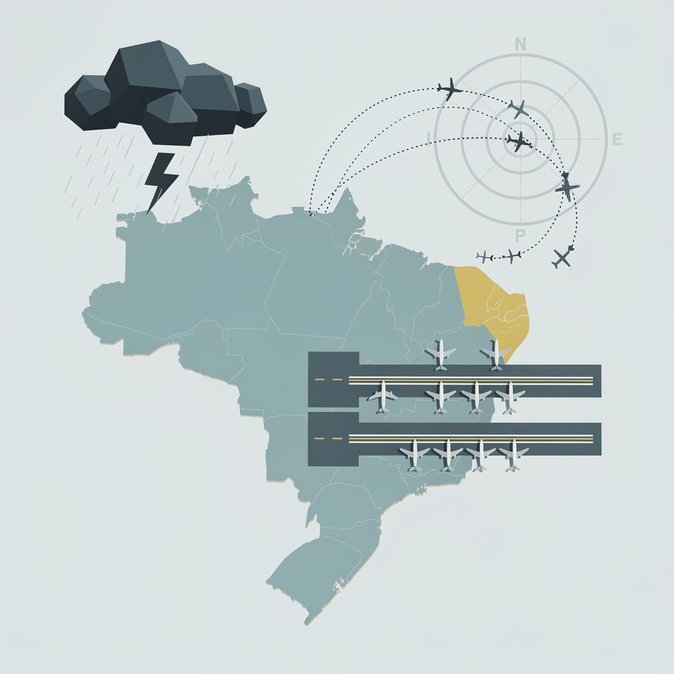
Brazil’s aviation network suffered widespread disruption on 3 July as a combination of winter storms and emergency rerouting around closed Venezuelan airspace forced airlines to cancel 79 flights and delay another 267. According to real-time flight-tracking data analysed by industry site Nomad Lawyer, the worst-hit hubs were São Paulo-Guarulhos (GRU) and Congonhas (CGH), followed by Brasília, Campinas and Belo Horizonte. The crisis unfolded after Venezuelan authorities temporarily restricted over-flights following a series of earthquakes near the country’s northern coast. Long-haul services between Brazil and North America or the Caribbean were compelled to detour hundreds of nautical miles, increasing block times and pushing crew rosters beyond legal limits. Simultaneously, a slow-moving cold front dumped heavy rain over south-eastern Brazil, reducing runway capacity at Guarulhos and Congonhas. LATAM Brasil and GOL each cancelled 31 services, while Azul logged the highest number of delayed departures (75). With narrow scheduling buffers during Brazil’s high winter-holiday season, the initial disruptions cascaded throughout the domestic network, stranding thousands of travellers and leaving business-critical cargo awaiting onward connections. Corporate travel managers should anticipate residual knock-on effects for at least 48 hours as airlines reposition aircraft and crews. Clients shipping time-sensitive components through Brazil may wish to activate contingency routings via Santiago or Buenos Aires until Venezuelan airspace re-opens. Meanwhile, ANAC (the civil-aviation regulator) has convened an emergency task-force to review whether slot-allocation rules at Congonhas should allow greater weather-related buffers. The episode is a reminder that geopolitical and climatic events beyond Brazil’s borders can quickly paralyse domestic mobility. Companies with rotational assignees in oil, mining and agribusiness corridors are advised to build extra layover time into itineraries during the Southern Hemisphere winter and to brief travellers on passenger-rights legislation (Resolution 400/2016) that guarantees re-accommodation or refunds in the event of long delays.
Source: Nomad Lawyer