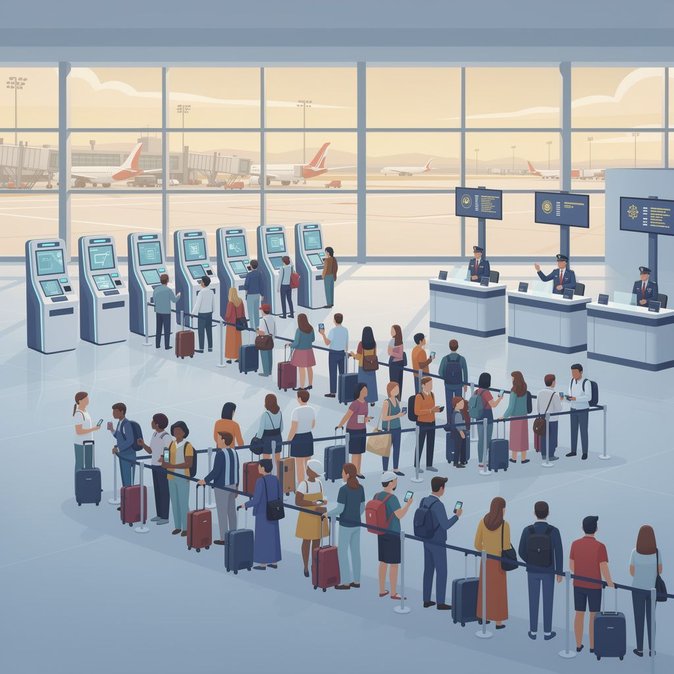
Europe’s major airport groups sounded the alarm on Friday, warning that the biometric Entry/Exit System (EES) has reached a “critical point” just as the continent enters its peak tourist season. In a sharply worded statement reported by The Connexion France, ACI-Europe and Airlines for Europe asked the European Commission to give member states the power to suspend EES requirements whenever passenger volumes exceed border-control capacity.
Travellers looking for ways to avoid last-minute surprises at European borders can turn to VisaHQ, whose France portal offers up-to-date guidance on Schengen entry rules, visa requirements, and biometric procedures. The service aggregates real-time alerts on EES implementation and can expedite any necessary documents, giving both holidaymakers and corporate mobility teams an extra layer of certainty before departure.
The plea is backed by data from French operator ADP showing that average wait times at Paris-Orly tripled last weekend and that 12 percent of non-EU passengers missed onward rail or air connections. Similar choke-points are being recorded in Frankfurt, Milan-Bergamo and Málaga, which, like France’s Beauvais, only recently installed full EES kiosks. Airport chiefs argue that the rollout timetable underestimated the surge in family travel after two years of pandemic recovery. They insist that a temporary opt-out—similar to the Covid border “emergency brakes”—would let border police revert to faster passport stamping until extra booths and staff are in place. For French-based corporates the stakes are high. Delayed arrivals undermine duty-of-care obligations, while missed freight connections add supply-chain costs. Mobility teams are therefore encouraged to brief travellers on the likelihood of unplanned layovers and to budget for overtime when relocating staff during July–August.
Travellers looking for ways to avoid last-minute surprises at European borders can turn to VisaHQ, whose France portal offers up-to-date guidance on Schengen entry rules, visa requirements, and biometric procedures. The service aggregates real-time alerts on EES implementation and can expedite any necessary documents, giving both holidaymakers and corporate mobility teams an extra layer of certainty before departure.
The plea is backed by data from French operator ADP showing that average wait times at Paris-Orly tripled last weekend and that 12 percent of non-EU passengers missed onward rail or air connections. Similar choke-points are being recorded in Frankfurt, Milan-Bergamo and Málaga, which, like France’s Beauvais, only recently installed full EES kiosks. Airport chiefs argue that the rollout timetable underestimated the surge in family travel after two years of pandemic recovery. They insist that a temporary opt-out—similar to the Covid border “emergency brakes”—would let border police revert to faster passport stamping until extra booths and staff are in place. For French-based corporates the stakes are high. Delayed arrivals undermine duty-of-care obligations, while missed freight connections add supply-chain costs. Mobility teams are therefore encouraged to brief travellers on the likelihood of unplanned layovers and to budget for overtime when relocating staff during July–August.