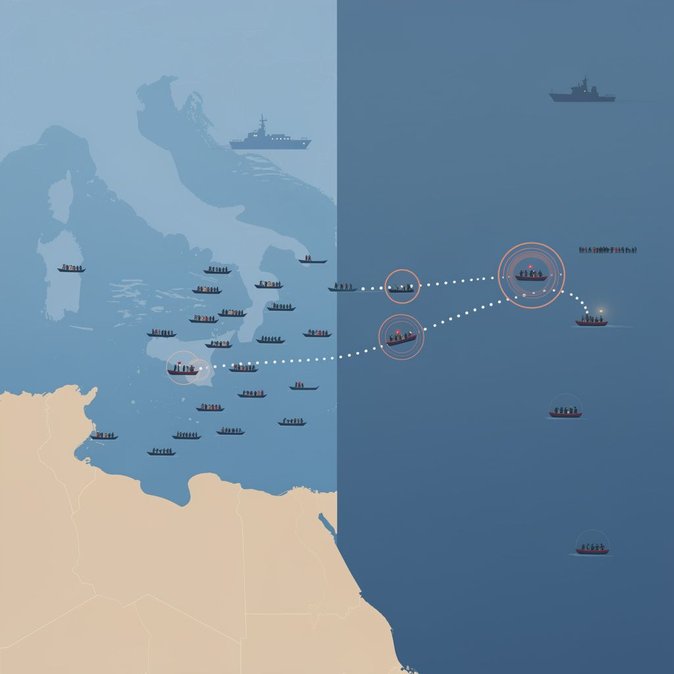
Fresh data released on 3 July by the Interior Ministry and analysed by news agency Agenzia Nova show a dramatic decline in irregular sea arrivals to Italy during the first half of 2026. Total landings stand at 14,464—down 52.7 % on the same period in 2025.
![Migrant Sea Arrivals to Italy Down 52 % Year-on-Year, Says Government Tracker]()
For organisations or individuals who need to understand how these changing migration dynamics might affect their own travel or relocation plans, VisaHQ offers detailed, continually updated visa information and application support through its Italy portal (https://www.visahq.com/italy/). The platform allows users to check requirements, compile digital forms and track submissions in real time, helping employers and assignees move forward with confidence even as policy gauges shift.
The most striking fall concerns the Libya route: 11,995 arrivals compared with 27,303 a year earlier, a drop of 56 %. Officials attribute the slide to a mix of factors: stepped-up Libyan coast-guard patrols funded under a 2025 EU Migration Compact, expanded humanitarian corridors for vulnerable groups, and Italy’s new fast-track return agreements with Tunisia and Egypt. At the same time, arrivals from Algeria more than doubled to 1,281, suggesting displacement to alternative routes. For global-mobility and relocation teams, fewer arrivals ease pressure on Italy’s reception centres, potentially reducing processing times for legal migrants, asylum seekers hired under the Decreto Flussi quotas and family-reunification applicants. However, NGOs warn that lower arrival numbers may mask riskier desert and sea crossings and a higher mortality rate per voyage. The data will feed into the EU’s upcoming “State of Schengen” review, where Italy will argue that external-border management investments are paying dividends. Companies relocating staff to southern regions may expect less media focus on “migration emergencies”, but should continue to monitor local political sentiment, which can influence permit procedures and social integration programmes.
For organisations or individuals who need to understand how these changing migration dynamics might affect their own travel or relocation plans, VisaHQ offers detailed, continually updated visa information and application support through its Italy portal (https://www.visahq.com/italy/). The platform allows users to check requirements, compile digital forms and track submissions in real time, helping employers and assignees move forward with confidence even as policy gauges shift.
The most striking fall concerns the Libya route: 11,995 arrivals compared with 27,303 a year earlier, a drop of 56 %. Officials attribute the slide to a mix of factors: stepped-up Libyan coast-guard patrols funded under a 2025 EU Migration Compact, expanded humanitarian corridors for vulnerable groups, and Italy’s new fast-track return agreements with Tunisia and Egypt. At the same time, arrivals from Algeria more than doubled to 1,281, suggesting displacement to alternative routes. For global-mobility and relocation teams, fewer arrivals ease pressure on Italy’s reception centres, potentially reducing processing times for legal migrants, asylum seekers hired under the Decreto Flussi quotas and family-reunification applicants. However, NGOs warn that lower arrival numbers may mask riskier desert and sea crossings and a higher mortality rate per voyage. The data will feed into the EU’s upcoming “State of Schengen” review, where Italy will argue that external-border management investments are paying dividends. Companies relocating staff to southern regions may expect less media focus on “migration emergencies”, but should continue to monitor local political sentiment, which can influence permit procedures and social integration programmes.