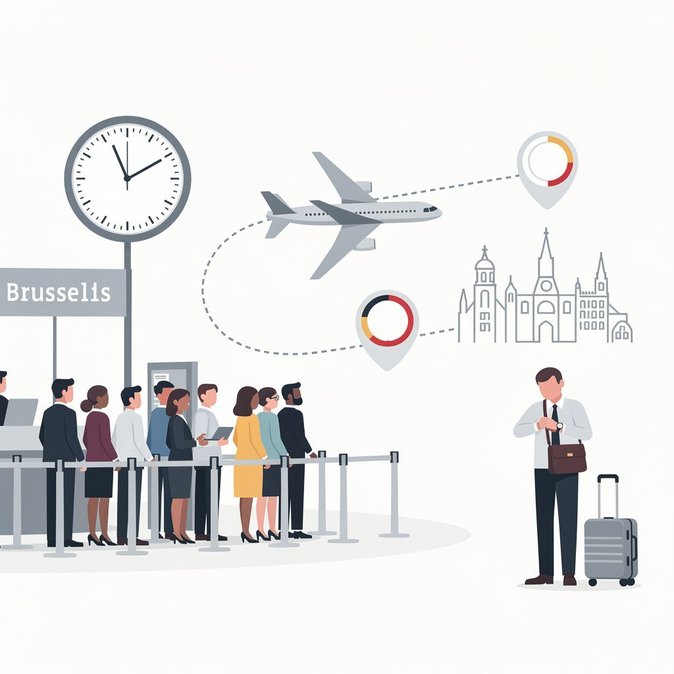
Germany’s independent travel-arbitration body has logged a 50 % jump in passenger grievances for the first half of 2026, the highest number ever recorded, with the EU’s biometric Entry/Exit System (EES) singled out as a primary culprit. The findings, published at 05:24 on 5 July by financial news portal Boerse-Global, note that Frankfurt and Munich are seeing queues of up to five hours and that airline hubs will need to rethink schedules if the trend continues. While the headlines focus on Germany, the repercussions extend directly to Belgium. Lufthansa lists Brussels as one of six core hubs in its new network strategy and has already warned that operational instability at German bases could spill over to Brussels through missed inbound connections and aircraft rotations. The airline plans to cut short- and medium-haul capacity by 2027, potentially increasing reliance on Brussels for feeder traffic. For Belgian mobility planners, the data underscore the urgency of monitoring EES performance continent-wide. Travellers transiting through Germany en route to Brussels, or vice-versa, should be advised to schedule at least three-hour layovers. Employers may also wish to leverage Belgium’s flexible telework rules to let cross-border staff work remotely if flight disruptions strand them abroad. The spike in complaints coincides with ongoing pilot-strike threats at Lufthansa and with rail-sector wage talks in neighbouring countries, raising fears of a perfect storm for European mobility this summer. Belgian authorities have so far declined to go beyond their current ‘flex-mode’ for EES, but mounting pressure from hub partners could push Brussels to advocate for a coordinated EU response. HR and global-mobility teams should update risk matrices to reflect the heightened likelihood of flight disruption across the Lufthansa and Star Alliance networks and consider pre-booking flexible or refundable fares for time-sensitive assignments into Belgium.
Source: Boerse-Global / Ad-Hoc-News