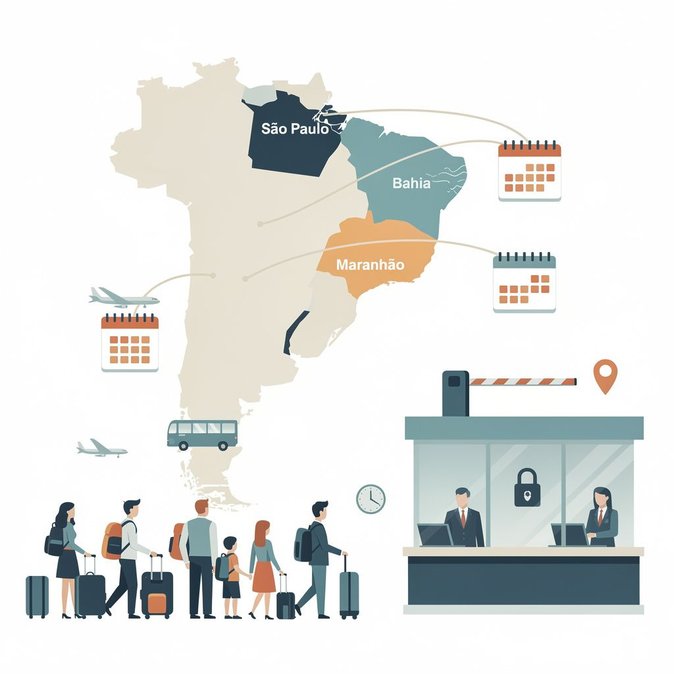
Brazil’s Ministry of Management published the final list of public-sector “ponto facultativo” bridge days on 5 July, confirming that São Paulo, Bahia and Maranhão will enjoy up to four consecutive days off in July. The biggest break is in São Paulo, where the 9 July Constitutional Revolution holiday (Thursday) is paired with a discretionary day on Friday 10 July under State Decree 70.273.
If navigating these sudden closures feels daunting, VisaHQ can help by arranging alternative appointment slots, providing document courier services and flagging workaround options so critical filings stay on track even when counters are shut. Their Brazil country desk— fast, online support for visa applications, passport renewals and other mobility needs.
In Bahia the state holiday marking Independence (2 July) already passed, but many municipalities, including Salvador, adopted 3 July as a compensatory bridge, creating a long weekend that overlaps with tourism demand spikes in the state’s coastal resorts. Maranhão’s Magna Date falls on Tuesday 28 July; municipalities can declare Monday 27 July optional, setting up another four-day stretch. Why does this matter for mobility teams? Public offices—including Police Federal immigration counters and Receita Federal customs desks—will close, potentially delaying visa-registration appointments, residence-permit collections and cargo clearances. Companies with July assignee start dates in São Paulo should reschedule CPF issuance and bank-account opening to the following week or use private-sector service channels that remain open. The feriadão also compresses domestic flight and hotel inventory. Historical data from ANAC show average São Paulo outbound fares rise 18 % in the fortnight preceding the 9 July holiday, particularly to winter hotspots such as Campos do Jordão and Gramado. Travel buyers are advised to secure tickets now or authorise cabin downgrades where policy permits. Mobility managers should circulate local-office guidance reminding employees that only public-sector workers automatically receive the Friday off; private-sector staff need employer approval. Where internal travel is unavoidable during the holiday window, build a one-day buffer for administrative steps reliant on state agencies.
If navigating these sudden closures feels daunting, VisaHQ can help by arranging alternative appointment slots, providing document courier services and flagging workaround options so critical filings stay on track even when counters are shut. Their Brazil country desk— fast, online support for visa applications, passport renewals and other mobility needs.
In Bahia the state holiday marking Independence (2 July) already passed, but many municipalities, including Salvador, adopted 3 July as a compensatory bridge, creating a long weekend that overlaps with tourism demand spikes in the state’s coastal resorts. Maranhão’s Magna Date falls on Tuesday 28 July; municipalities can declare Monday 27 July optional, setting up another four-day stretch. Why does this matter for mobility teams? Public offices—including Police Federal immigration counters and Receita Federal customs desks—will close, potentially delaying visa-registration appointments, residence-permit collections and cargo clearances. Companies with July assignee start dates in São Paulo should reschedule CPF issuance and bank-account opening to the following week or use private-sector service channels that remain open. The feriadão also compresses domestic flight and hotel inventory. Historical data from ANAC show average São Paulo outbound fares rise 18 % in the fortnight preceding the 9 July holiday, particularly to winter hotspots such as Campos do Jordão and Gramado. Travel buyers are advised to secure tickets now or authorise cabin downgrades where policy permits. Mobility managers should circulate local-office guidance reminding employees that only public-sector workers automatically receive the Friday off; private-sector staff need employer approval. Where internal travel is unavoidable during the holiday window, build a one-day buffer for administrative steps reliant on state agencies.