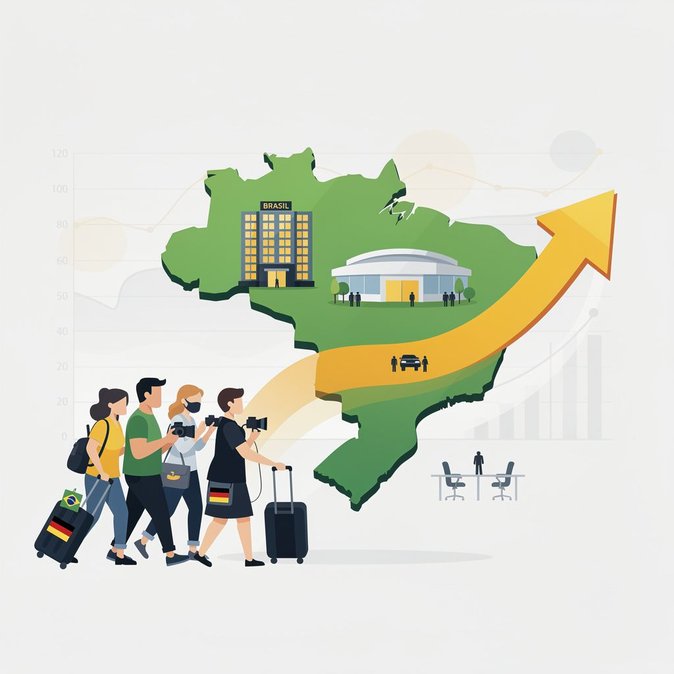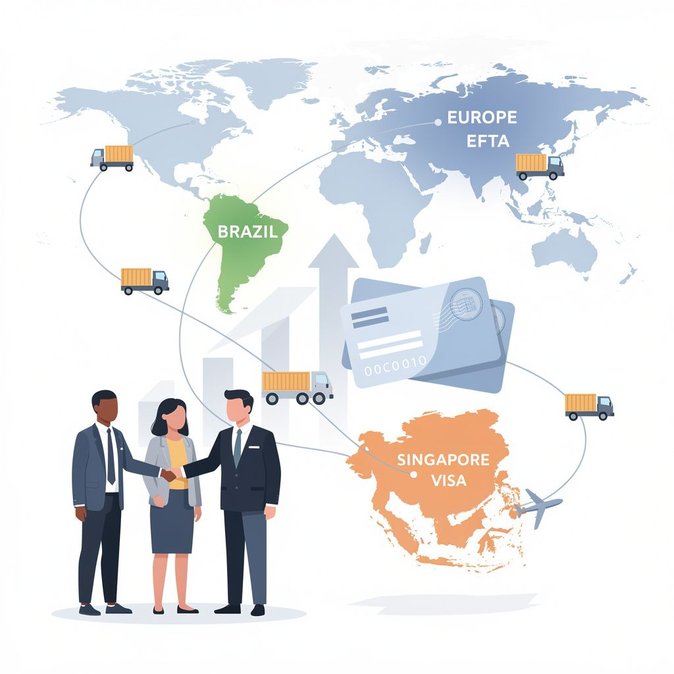
The Brazilian government confirmed on 3 July 2026 that it has deposited the instruments of ratification for Mercosur’s free-trade agreements (FTAs) with the European Free Trade Association (EFTA) and Singapore, clearing the last hurdle for the pacts to enter into force on 1 August. While media attention has focused on tariff reductions, both FTAs include dedicated chapters on the temporary entry of businesspersons—a first for Mercosur agreements. Under the EFTA accord, intra-corporate transferees, contractual service suppliers and independent professionals from Brazil will be eligible for work permits of up to 24 months (extendable to 36 months) in Switzerland, Norway, Iceland and Liechtenstein without labour-market tests, provided they remain on the Brazilian payroll.
For companies that lack in-house mobility teams, specialised providers can shoulder the administrative load. VisaHQ, for example, already supports Brazilian clients with visa and work-permit filings worldwide and will be able to guide employers through the new EFTA and Singapore schemes. Its Brazil portal offers up-to-date checklists, fee calculators and a customer dashboard that tracks each employee’s application in real time, reducing the risk of delays as the 1 August start date approaches.
A fast-track visa lane capped at 180 days per year is created for installers and maintenance technicians supporting post-sale contracts—particularly important for Brazil’s heavy-machinery exporters. The Singapore deal goes further, carving out a ‘Mobility for Innovation’ category that grants five-year passes to senior managers of Brazilian tech companies investing at least SG$2 million. Singapore will also accept Brazilian e-signatures for corporate filings and recognise Brazilian professional licences in engineering and architecture, cutting red tape for project-based assignments. Brazil reciprocates by extending the existing Mercosur temporary-entry visa (RN 118) to EFTA and Singapore nationals for stays of up to two years, renewable once. The Ministry of Justice has 60 days to publish implementing ordinances that will align police-registration rules with the new FTAs. For HR departments, the agreements mean shorter lead times for visa issuance—EFTA members commit to 10 working days—and more predictable rules for social-security coverage thanks to the cross-border worker provisions. Companies should start mapping employees who may be eligible for the new categories and review assignment cost projections, as host-country payroll requirements differ between Switzerland and Singapore.
For companies that lack in-house mobility teams, specialised providers can shoulder the administrative load. VisaHQ, for example, already supports Brazilian clients with visa and work-permit filings worldwide and will be able to guide employers through the new EFTA and Singapore schemes. Its Brazil portal offers up-to-date checklists, fee calculators and a customer dashboard that tracks each employee’s application in real time, reducing the risk of delays as the 1 August start date approaches.
A fast-track visa lane capped at 180 days per year is created for installers and maintenance technicians supporting post-sale contracts—particularly important for Brazil’s heavy-machinery exporters. The Singapore deal goes further, carving out a ‘Mobility for Innovation’ category that grants five-year passes to senior managers of Brazilian tech companies investing at least SG$2 million. Singapore will also accept Brazilian e-signatures for corporate filings and recognise Brazilian professional licences in engineering and architecture, cutting red tape for project-based assignments. Brazil reciprocates by extending the existing Mercosur temporary-entry visa (RN 118) to EFTA and Singapore nationals for stays of up to two years, renewable once. The Ministry of Justice has 60 days to publish implementing ordinances that will align police-registration rules with the new FTAs. For HR departments, the agreements mean shorter lead times for visa issuance—EFTA members commit to 10 working days—and more predictable rules for social-security coverage thanks to the cross-border worker provisions. Companies should start mapping employees who may be eligible for the new categories and review assignment cost projections, as host-country payroll requirements differ between Switzerland and Singapore.