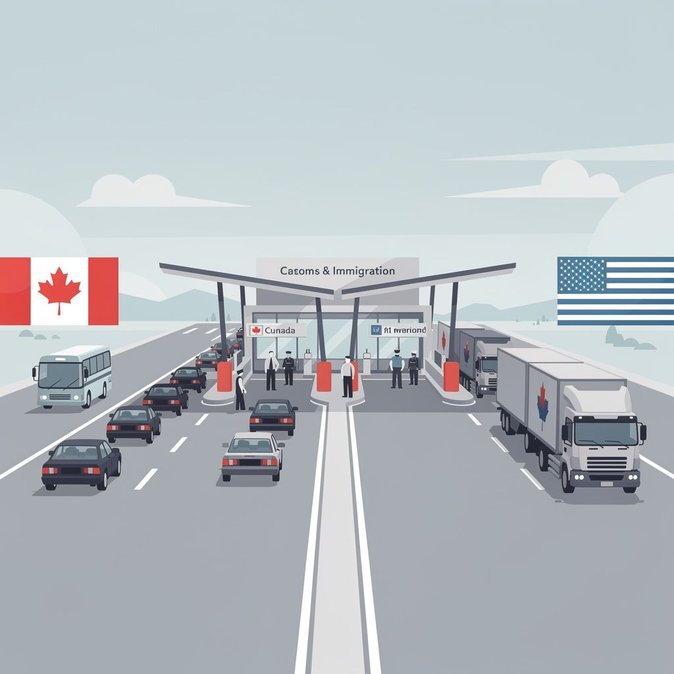
The governments of Canada and the United States have reached a long-awaited agreement that will see joint pre-inspection facilities built at four of the busiest land crossings along the 8,900-kilometre frontier. Under the deal—confirmed on 5 July by Public Safety Canada and the U.S. Department of Homeland Security—full passenger-vehicle and commercial-truck preclearance will begin on 1 September 2026 at Coutts/Sweetgrass (Alberta–Montana), Derby Line/Stanstead (Vermont–Québec), Peace Bridge (Fort Erie–Buffalo) and Pacific Highway/Blaine (British Columbia–Washington). The two countries will share a combined US $180 million in infrastructure costs, with the Canada Border Services Agency (CBSA) acting as lead contractor on the Canadian side. Preclearance means that travellers will complete customs and immigration formalities before crossing the actual border, similar to the model already in place at eight Canadian airports. Ottawa projects that average wait times for passenger vehicles could fall by 40 % during peak summer hours and that dedicated FAST and C-TPAT lanes for trusted trucking companies will reduce cargo dwell times by up to 60 %. For business travellers, same-day return trips between Calgary and northern Montana or between Vancouver’s Fraser Valley and the Seattle tech corridor will become significantly quicker and more predictable. The announcement follows a three-year pilot at the Peace Bridge that cut processing times by up to 90 minutes and reduced greenhouse-gas emissions from idling engines by an estimated 5,000 tonnes annually. Both governments say the new sites were selected on the basis of traffic volumes, cross-border supply-chain dependency and local economic integration. Additional crossings—including the Ambassador Bridge (Windsor–Detroit) and Sarnia’s Blue Water Bridge—are scheduled for feasibility studies in 2027-28. Commercial implications are substantial. Roughly C$2.9 billion in merchandise moves across the four chosen crossings every day, and trucking associations have long argued that unpredictable border queues add as much as C$500 million a year in extra fuel, labour and inventory-carrying costs. Tourism boards in Alberta, Québec and British Columbia also expect the faster, 24-hour processing model to stimulate short-stay leisure traffic during the 2026-27 ski and holiday seasons. Practical tips for corporate mobility managers: register frequent drivers for FAST cards before the 15 August cut-off; update corporate travel policies to reflect the new requirement to submit pre-arrival declarations through the CBSA/CBP Pre-Clear mobile app; and advise travellers that secondary inspections may still occur at random, so original work-permit or eTA documentation should be kept on hand.
Source: Atlas Guide / Reuters