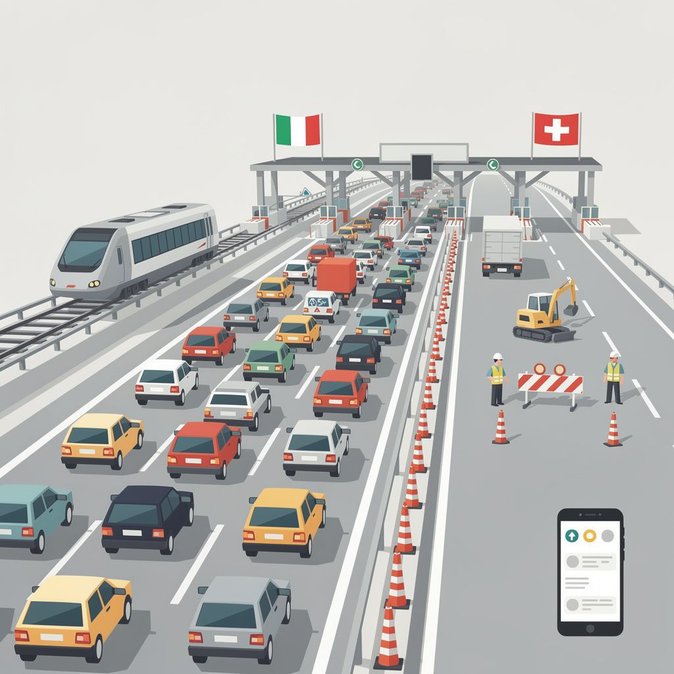
Cross-border commuters and holidaymakers faced an unwelcome bottleneck on 5 July as wait times at the Chiasso–Brogeda motorway crossing climbed to 30 minutes at the 08:00 peak, roughly triple the seasonal average. Real-time data published by the Ticino portal FrontaliereTicino shortly after 09:00 confirmed sustained delays throughout the morning. What is happening. Traffic analysts blame the perfect storm of the first official summer-holiday weekend in Lombardy, ongoing resurfacing works on the Italian A9, and intensified customs spot-checks after recent seizures of undeclared cash. Although Switzerland and Italy are both in Schengen, the Federal Office for Customs and Border Security (BAZG) retains the right to carry out customs inspections—a fact many leisure travellers forget when loading up on duty-free fuel and groceries. Impact on global mobility. Some 75 000 cross-border workers (frontalieri) travel daily between Como province and southern Ticino. A 20-minute delay each way equates to a collective 25 000 lost labour hours per day—roughly CHF 650 000 in wage costs—if the congestion persists. Swiss employers face punctuality issues, while Italian employees risk exceeding the 25 per cent work-from-home allowance under the 2024 bilateral tax protocol if they decide to telework instead of crossing. Mitigation strategies. • Shift start times: companies can stagger morning shifts to 10:00 to exploit the historical lull between 10:00 and 12:00 when waits drop below 10 minutes. • Alternative crossings: Brogeda’s secondary routes—Chiasso–Strada or Bizzarone—showed single-digit queues for most of the morning. • Rail option: the TILO S40/S50 commuter lines ran on time, offering a 55-minute Como S. Giovanni–Lugano ride that bypasses road bottlenecks. Longer-term outlook. BAZG plans to introduce an automated ‘green-lane’ for pre-registered commuters in 2027, but funding is not secured. Until then, motorists must rely on live-traffic apps and early departures. The portal has added push alerts that notify users when waiting time exceeds a self-defined threshold—worth activating before Monday’s rush.