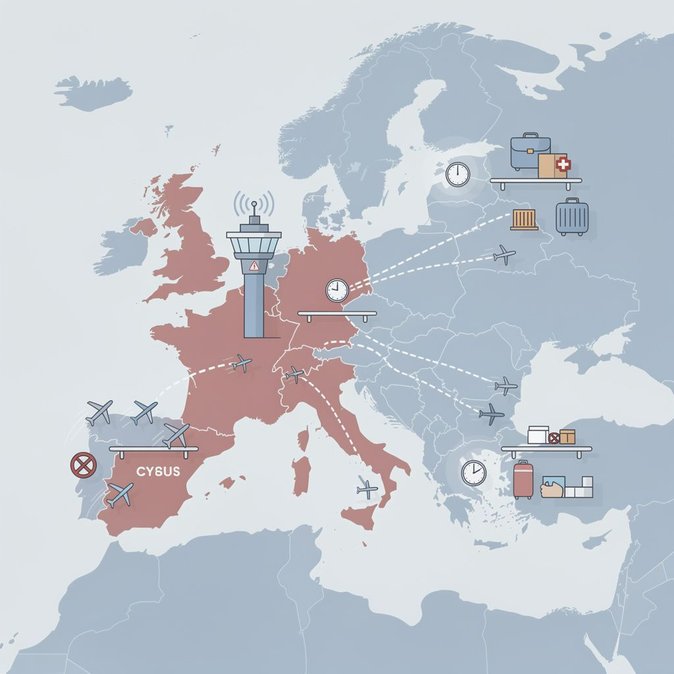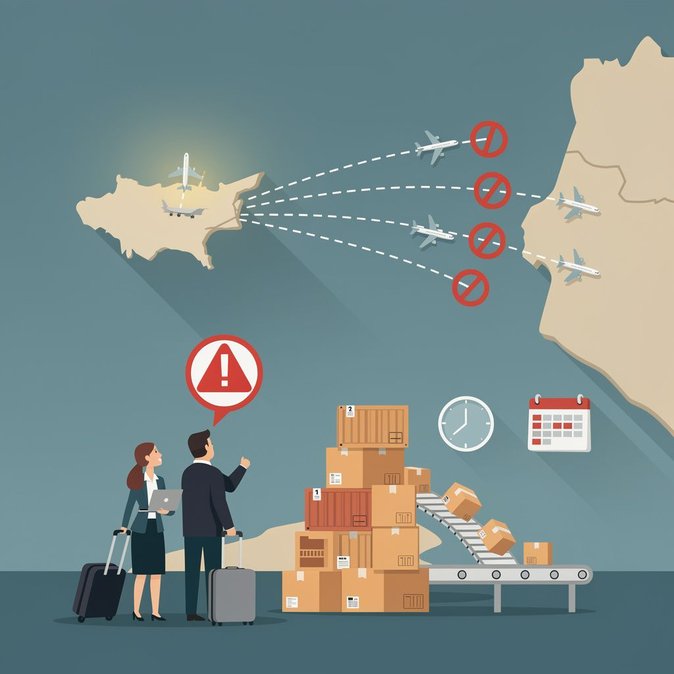
Cyprus’ main gateway suddenly felt the shockwaves of the latest Middle-East escalation on Sunday, 5 July, when airlines scrubbed nine arrivals from Tel Aviv and two from Haifa over security fears. According to airport operator Hermes and flight boards reviewed at 09:30 local time, Israir, Arkia, Air Haifa, Aegean and Cyprus Airways jointly pulled all daylight flights that normally connect Israel with Larnaca, citing an Israeli NOTAM that kept Ben Gurion airspace closed after overnight drone-and-missile exchanges between Israel and Iran. The cancellations began with Israir’s 09:45 6H 588 and continued through Cyprus Airways’ late-evening CY 112, wiping roughly 1,500 seats off the busy Sunday schedule. While Jordan and Lebanon reopened their airspace by mid-morning, Israel’s remained restricted, leaving airlines little room to re-time rotations. Cyprus’ Transport Ministry confirmed the island’s FIR and airports were operating normally but stressed that “safety assessments by each carrier must be respected.” Business travellers heading for Monday meetings in Nicosia or Limassol were advised to reroute via Athens or Istanbul, though connection space was already tight. The sudden gap highlights how exposed Cyprus is to regional flashpoints. Israel is its third-largest source of visitors and a critical market for the island’s tech-outsourcing sector; offices in Larnaca’s new business district rely on the sub-one-hour hop for project teams shuttling to Tel Aviv. Travel-risk advisers told multinationals to activate contingency plans that include remote log-ins and hybrid meeting options for at least the next 48 hours. Freight forwarders also warned of potential knock-on delays for high-value semiconductor components that normally move in the belly-holds of the affected narrow-body flights. From a compliance standpoint, employers should remember that cancelled flights do not pause short-stay Schengen-style day-counters. Non-EU assignees on the 90/180-day clock must record the extra days they now spend in Cyprus; overstays can trigger future entry bans. Immigration counsel recommend filing for a “Special Case” extension (Category V) if the disruption stretches beyond this week. Longer term, the incident will feed into the government’s pitch for a second runway at Larnaca that would improve scheduling flexibility. Hermes says an updated master-plan will be lodged with the Planning Department by year-end, with specific reference to resilience against regional security events. For now, passengers booked on Israel–Cyprus sectors over the next three days should check airline apps frequently and keep boarding passes for potential EU-261 compensation claims if their carrier is EU-based or departs from an EU airport.
Source: Philenews