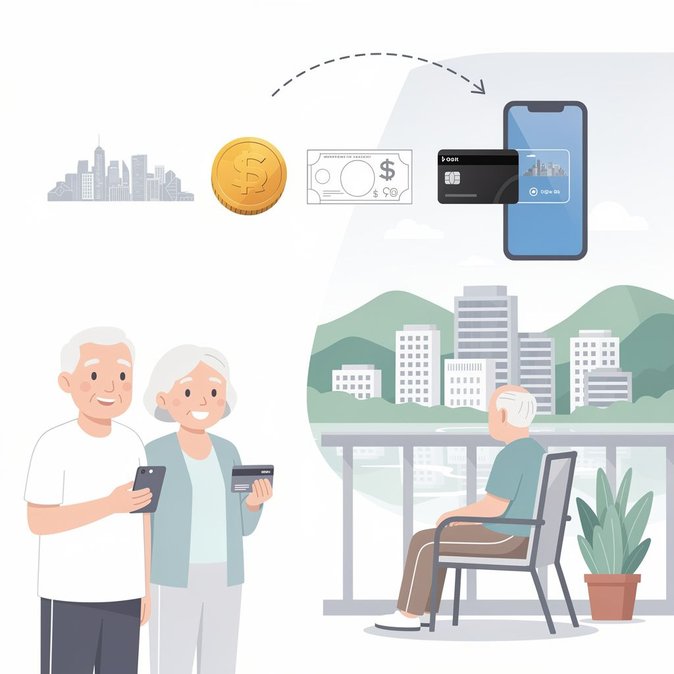
The Social Welfare Department (SWD) has quietly removed a longstanding administrative hurdle for thousands of Hong Kong retirees who have taken advantage of the Portable Comprehensive Social Security Assistance (CSSA) Scheme and related Old Age Allowance programmes on the mainland. A notice on the Guangdong Scheme website dated 6 July confirms that, with immediate effect, beneficiaries may opt to receive their monthly payments in Hong Kong Dollars credited directly into HKD accounts at designated mainland banks—at no charge. Previously, recipients who settled in Guangdong or Fujian had to maintain a Hong Kong bank account or accept payments in Renminbi converted at prevailing rates, exposing them to forex risk and transfer fees.
Although the new payment option streamlines welfare transfers, retirees still need to maintain valid travel documents and entry permits for their cross-boundary lifestyle. VisaHQ’s Hong Kong office can assist individuals and corporate HR teams with fast, reliable processing of China visas, Home Return Permits, and other consular paperwork, ensuring that administrative details don’t derail the benefits of the updated scheme.
The new cross-border remittance channel, negotiated with Chinese clearing banks operating under the Cross-boundary RMB Settlement pilot, allows funds to move through the city’s Faster Payment System before settling in HKD onshore. For global mobility and reward teams, the tweak has two implications. First, it may encourage more near-retirement employees—particularly lower-paid manufacturing staff—to opt for “reverse-expatriation” back to the Greater Bay Area while retaining Hong Kong welfare ties, reducing the company’s housing liabilities. Second, the precedent of fee-free HKD remittance could pave the way for broader pension-portability solutions, a topic the Mandatory Provident Fund Authority is studying in parallel. Practical steps: employers providing compensation top-ups tied to CSSA or OALA benchmarks should verify whether net-of-fees clauses need revision, and frontline HR should remind eligible leavers that they must still meet the 60-day annual residence rule in Guangdong/Fujian to retain payout status. The SWD has not published volume targets, but industry groups such as the Federation of Hong Kong Industries estimate up to 55,000 retirees could switch to the new arrangement within a year, easing remittance frictions and supporting cross-boundary living for the city’s ageing workforce.

Although the new payment option streamlines welfare transfers, retirees still need to maintain valid travel documents and entry permits for their cross-boundary lifestyle. VisaHQ’s Hong Kong office can assist individuals and corporate HR teams with fast, reliable processing of China visas, Home Return Permits, and other consular paperwork, ensuring that administrative details don’t derail the benefits of the updated scheme.
The new cross-border remittance channel, negotiated with Chinese clearing banks operating under the Cross-boundary RMB Settlement pilot, allows funds to move through the city’s Faster Payment System before settling in HKD onshore. For global mobility and reward teams, the tweak has two implications. First, it may encourage more near-retirement employees—particularly lower-paid manufacturing staff—to opt for “reverse-expatriation” back to the Greater Bay Area while retaining Hong Kong welfare ties, reducing the company’s housing liabilities. Second, the precedent of fee-free HKD remittance could pave the way for broader pension-portability solutions, a topic the Mandatory Provident Fund Authority is studying in parallel. Practical steps: employers providing compensation top-ups tied to CSSA or OALA benchmarks should verify whether net-of-fees clauses need revision, and frontline HR should remind eligible leavers that they must still meet the 60-day annual residence rule in Guangdong/Fujian to retain payout status. The SWD has not published volume targets, but industry groups such as the Federation of Hong Kong Industries estimate up to 55,000 retirees could switch to the new arrangement within a year, easing remittance frictions and supporting cross-boundary living for the city’s ageing workforce.