Hong Kong International Airport has quietly entered its next expansion phase with the soft-opening of departure facilities in the fully rebuilt Terminal 2 (T2). Engineering consultancy SYSTRA confirmed the milestone in a release dated 6 July 2026, hailing the hand-over as a key deliverable of the airport’s HK$141 billion Three-Runway System programme.
Unlike the pre-2020 configuration—where T2 served only as an upstream check-in hall—the new building offers end-to-end departure processing. Travellers complete check-in, security, and immigration under one roof before boarding the Automated People Mover to reach airside gates in Terminal 1.
Over the next 18 months, a new pier will attach directly to T2, ultimately giving Hong Kong a dual-terminal layout capable of handling 120 million passengers annually. For mobility teams, the biggest immediate benefit is shorter kerb-to-gate times for corporate groups.
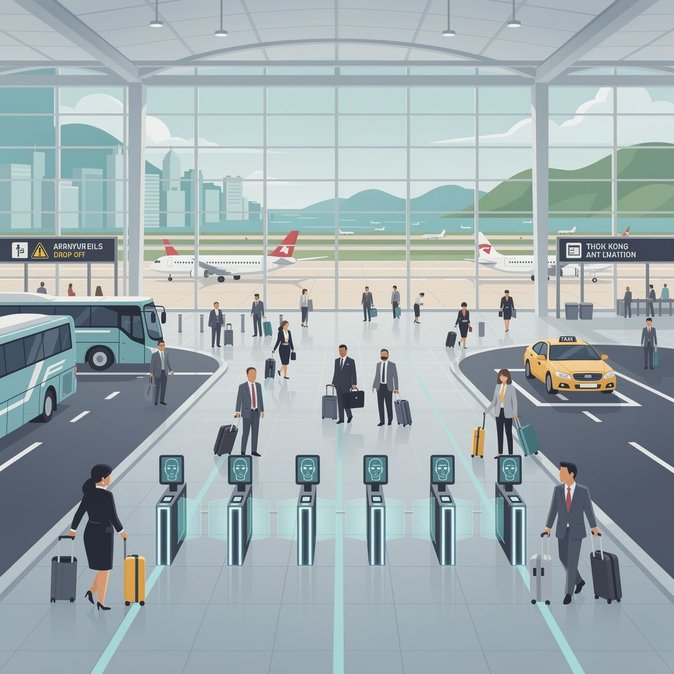
The redesigned landside forecourt integrates Airport Express, franchised buses, cross-boundary coaches and a 1,000-bay car park via weather-proof walkways—critical for firms shuttling assignees between the airport and Greater Bay Area manufacturing hubs.
Inside, processing halls are equipped with 50 e-gates compatible with HKSAR smart IDs and biometric passports, reflecting the government’s push towards frictionless border clearance.
Whether you’re a road warrior flying out on short notice or a relocation manager coordinating group moves, VisaHQ can smooth the paperwork side of the journey. Its Hong Kong platform consolidates visa requirements, online applications and real-time status alerts, ensuring travellers have the right documents in hand before stepping into T2’s new e-gate lanes.
The phased opening is also a signal that Hong Kong is preparing for a return to peak traffic volumes. May passenger throughput reached 5.34 million, up 10.2 % year-on-year, and AAHK projects double-digit growth for the summer peak as Cathay Pacific reinstates suspended Middle East and European services.
Companies with regional headquarters in Hong Kong should review their employee travel playbooks: redrawing rendezvous points, updating ground-transport SOPs, and reminding staff that some carriers now check in exclusively at T2.
By the time the boarding pier is finished in late 2027, Terminal 2 will house its own immigration arrival hall, swing-gates for low-cost carriers, and a retail footprint aimed at wooing mainland shoppers.
For now, the partial opening restores redundancy to a hub that lost capacity during pandemic-era works—and reinforces Hong Kong’s status as the natural gateway for talent flows into the Greater Bay Area.
Unlike the pre-2020 configuration—where T2 served only as an upstream check-in hall—the new building offers end-to-end departure processing. Travellers complete check-in, security, and immigration under one roof before boarding the Automated People Mover to reach airside gates in Terminal 1.
Over the next 18 months, a new pier will attach directly to T2, ultimately giving Hong Kong a dual-terminal layout capable of handling 120 million passengers annually. For mobility teams, the biggest immediate benefit is shorter kerb-to-gate times for corporate groups.
The redesigned landside forecourt integrates Airport Express, franchised buses, cross-boundary coaches and a 1,000-bay car park via weather-proof walkways—critical for firms shuttling assignees between the airport and Greater Bay Area manufacturing hubs.
Inside, processing halls are equipped with 50 e-gates compatible with HKSAR smart IDs and biometric passports, reflecting the government’s push towards frictionless border clearance.
Whether you’re a road warrior flying out on short notice or a relocation manager coordinating group moves, VisaHQ can smooth the paperwork side of the journey. Its Hong Kong platform consolidates visa requirements, online applications and real-time status alerts, ensuring travellers have the right documents in hand before stepping into T2’s new e-gate lanes.
The phased opening is also a signal that Hong Kong is preparing for a return to peak traffic volumes. May passenger throughput reached 5.34 million, up 10.2 % year-on-year, and AAHK projects double-digit growth for the summer peak as Cathay Pacific reinstates suspended Middle East and European services.
Companies with regional headquarters in Hong Kong should review their employee travel playbooks: redrawing rendezvous points, updating ground-transport SOPs, and reminding staff that some carriers now check in exclusively at T2.
By the time the boarding pier is finished in late 2027, Terminal 2 will house its own immigration arrival hall, swing-gates for low-cost carriers, and a retail footprint aimed at wooing mainland shoppers.
For now, the partial opening restores redundancy to a hub that lost capacity during pandemic-era works—and reinforces Hong Kong’s status as the natural gateway for talent flows into the Greater Bay Area.