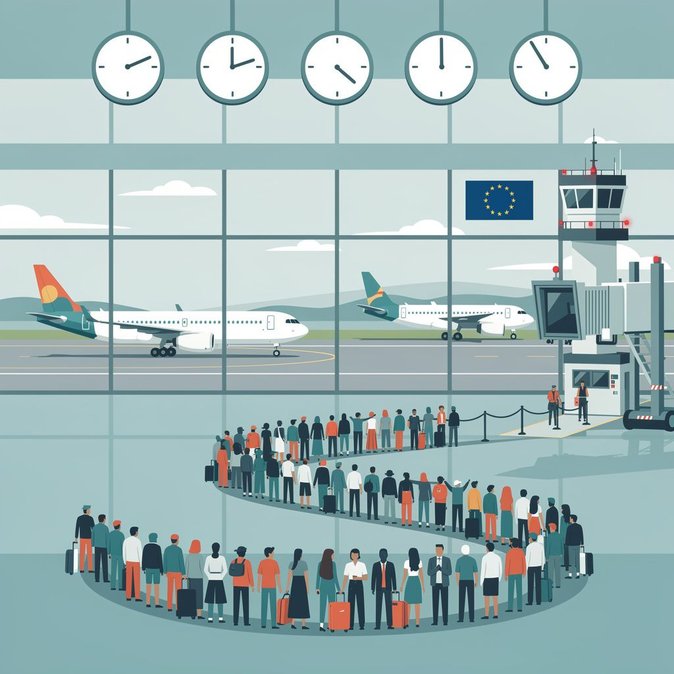
Business and leisure passengers flying into or out of Ireland face a perfect storm this summer after new data confirmed that Dublin Airport expects roughly 11 million travellers between May and October 2026—300,000 more than in 2025. The surge comes while the airport is still legally capped at 32 million passengers a year, meaning every extra traveller pushes existing infrastructure closer to its limits. Airlines are already scaling back schedules: Aer Lingus has pulled more than 500 flights because heavy-maintenance slots for long-haul aircraft were delayed, and Ryanair has trimmed close to 10 % of its planned Dublin programme in protest at the passenger cap and rising charges. Slot co-ordinators and the Irish Aviation Authority warn that the reduced schedule does not translate into quieter terminals.
Whether your trip is for business, leisure or a mix of both, making sure your travel documents are in order can help offset some of the stress caused by these operational bottlenecks. VisaHQ’s online platform streamlines visa and passport services for travellers heading to or transiting through Ireland, providing up-to-date entry requirements, digital application tools and dedicated support so you spend less time on paperwork and more time navigating the airport’s challenges.
Instead, demand is being funnelled onto fewer departures, driving higher load factors and lengthening queues at check-in, security and U.S. pre-clearance. Air-traffic-control staffing gaps are compounding the problem; repeated short-notice sector closures this spring forced rerouting and caused knock-on delays across the network. Industrial action on the Continent—most recently by Belgian controllers—has already cancelled more than 100 flights used by Irish holiday-makers. daa, the airport operator, has deployed computed-tomography scanners that allow passengers to keep liquids and electronics in cabin bags, but historical data show security wait times spike quickly when staffing or equipment availability dips. Independent queue-time trackers recorded several peaks above 50 minutes during the June bank-holiday weekend despite the new scanners. Industry submissions to the Oireachtas Transport Committee argue that without legislative action to lift the planning cap, chronic congestion risks damaging Ireland’s attractiveness as a European hub and could push investors and tourists to rival airports in Amsterdam, Paris or London. For corporate mobility managers the message is clear: advise assignees and visiting executives to arrive at least three hours before European departures and four hours before trans-Atlantic flights, book flexible or fully refundable tickets where possible, and incorporate buffer time into meeting schedules. Travel-management companies are also urging firms to revisit ‘bleisure’ policies, reminding employees that EU compensation rules apply when delays exceed three hours on flights operated by EU carriers or departing from an EU airport. Until new legislation passes, delays and crowding are set to be the defining feature of Ireland’s 2026 peak-season travel.
Whether your trip is for business, leisure or a mix of both, making sure your travel documents are in order can help offset some of the stress caused by these operational bottlenecks. VisaHQ’s online platform streamlines visa and passport services for travellers heading to or transiting through Ireland, providing up-to-date entry requirements, digital application tools and dedicated support so you spend less time on paperwork and more time navigating the airport’s challenges.
Instead, demand is being funnelled onto fewer departures, driving higher load factors and lengthening queues at check-in, security and U.S. pre-clearance. Air-traffic-control staffing gaps are compounding the problem; repeated short-notice sector closures this spring forced rerouting and caused knock-on delays across the network. Industrial action on the Continent—most recently by Belgian controllers—has already cancelled more than 100 flights used by Irish holiday-makers. daa, the airport operator, has deployed computed-tomography scanners that allow passengers to keep liquids and electronics in cabin bags, but historical data show security wait times spike quickly when staffing or equipment availability dips. Independent queue-time trackers recorded several peaks above 50 minutes during the June bank-holiday weekend despite the new scanners. Industry submissions to the Oireachtas Transport Committee argue that without legislative action to lift the planning cap, chronic congestion risks damaging Ireland’s attractiveness as a European hub and could push investors and tourists to rival airports in Amsterdam, Paris or London. For corporate mobility managers the message is clear: advise assignees and visiting executives to arrive at least three hours before European departures and four hours before trans-Atlantic flights, book flexible or fully refundable tickets where possible, and incorporate buffer time into meeting schedules. Travel-management companies are also urging firms to revisit ‘bleisure’ policies, reminding employees that EU compensation rules apply when delays exceed three hours on flights operated by EU carriers or departing from an EU airport. Until new legislation passes, delays and crowding are set to be the defining feature of Ireland’s 2026 peak-season travel.