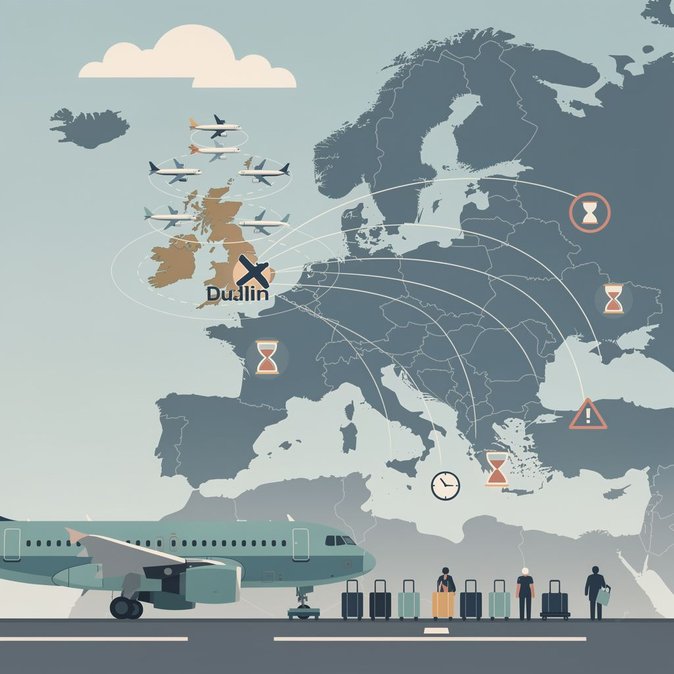
Passengers arriving at Dublin Airport on Sunday, 5 July found queues snaking far beyond the terminal doors after a sudden spike in European air-traffic congestion rippled across Ireland’s busiest hub. According to live-ops data cited by Travel & Tour World, 141 flights were delayed and another five were cancelled by lunchtime, affecting services operated by Aer Lingus, Ryanair, Emirates and several European carriers. Although no single technical fault was identified, the Dublin Airport Authority (DAA) said the knock-on disruption was aggravated by staff shortages in European control centres, runway works in Amsterdam and Frankfurt that have reduced slot capacity, and thunderstorms moving through western France. Those factors forced aircraft to hold on the ground in Dublin, creating a vicious circle of late inbound crews and aircraft. Business travellers were hit hardest during the early-morning wave between 06:00 and 09:30, when more than half of scheduled departures left late. Global mobility managers advised corporate travellers to build extra buffers into Monday-morning meetings and to use airline apps for real-time rebooking. “We are seeing 45- to 90-minute delays on core European trunk routes – Brussels, Frankfurt, Heathrow – and that can cascade into missed connections for long-haul itineraries,” said Niall Murray, travel operations lead at a multinational tech firm in Dublin’s Docklands. Airlines responded in different ways. Aer Lingus offered free re-routing onto later same-day services for anyone booked on flights DUB-LHR, DUB-BRU or DUB-CDG. Ryanair advised passengers to arrive the usual two hours before short-haul departures but to expect “longer-than-normal” times at security and boarding. Emirates switched its Dubai flight EK162 to a larger Boeing 777-300ER to accommodate displaced passengers. While DAA has invested heavily in self-service bag-drop and e-gates, industry bodies say Ireland remains exposed to wider European system shocks. The European Network Manager forecasts further strain later in July when the Paris Olympics begin. Irish businesses with time-critical mobility assignments are being urged to keep flexible tickets and to review contingency policies for staff travelling on connecting itineraries via continental hubs.
Source: Travel & Tour World