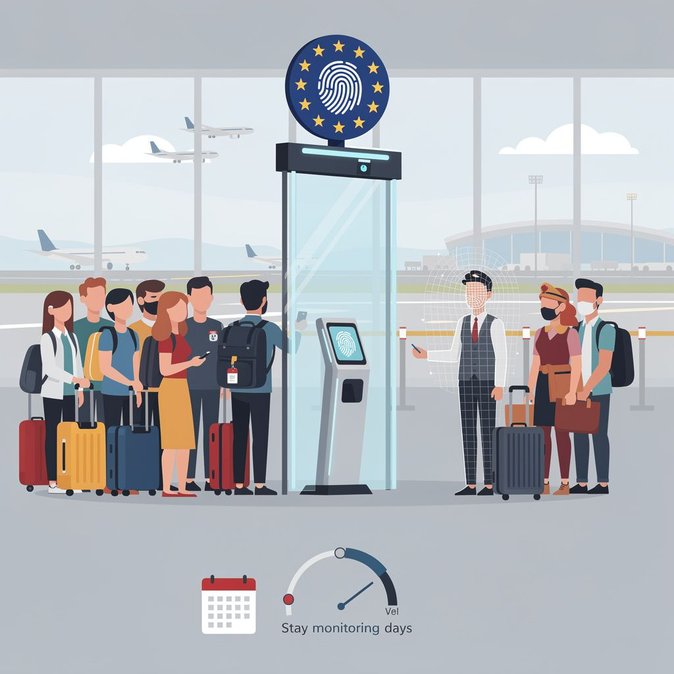
The European Commission has rebuffed urgent pleas from Europe’s airports and airlines to suspend the new Entry/Exit System (EES) until after the peak-summer rush, insisting the digital border-control platform is here to stay. Speaking to reporters on 8 July 2026, officials said completely switching off EES would create “bigger chaos” by producing an uneven patchwork of rules across the Schengen Area. Instead, Brussels will give member states limited flexibility—such as temporary biometric-registration waivers at individual crossings—until early September. The EES became fully operational on 10 April 2026 and replaced passport stamping with facial-image and fingerprint enrolment for all third-country travellers. Prague’s Václav Havel Airport, Brno–Tuřany Airport and the country’s land borders with Germany, Austria, Poland and Slovakia all now run the system. For Czech companies moving staff or hosting conferences, the main impact has been longer queues at external EU hubs (notably Paris-CDG and Rome-FCO) and tighter enforcement of the 90/180-day stay rule for their non-EU guests. Industry groups IATA, ACI Europe and Airlines for Europe had warned of five-hour lines and missed connections, but EU migration chief Magnus Brunner countered that only 20 of 1,500 crossing points are “problematic”. He urged carriers and airports to bolster staffing and kiosks rather than blaming the technology. Practical takeaway for Czech employers: brief incoming non-EU travellers to arrive earlier, keep proof of prior Schengen entries handy, and avoid back-to-back itineraries that rely on tight connections inside the zone until the initial bedding-in period ends in September. Forward-planning is equally vital for Czech nationals who manage global teams from Prague but hold third-country passports, as overstays could trigger €500–€10,000 fines or Schengen bans. Looking ahead, discussions in Brussels suggest no appetite for a blanket suspension, meaning Czech travel managers should treat EES as the “new normal” and adjust corporate-mobility policies accordingly.
Source: The Local