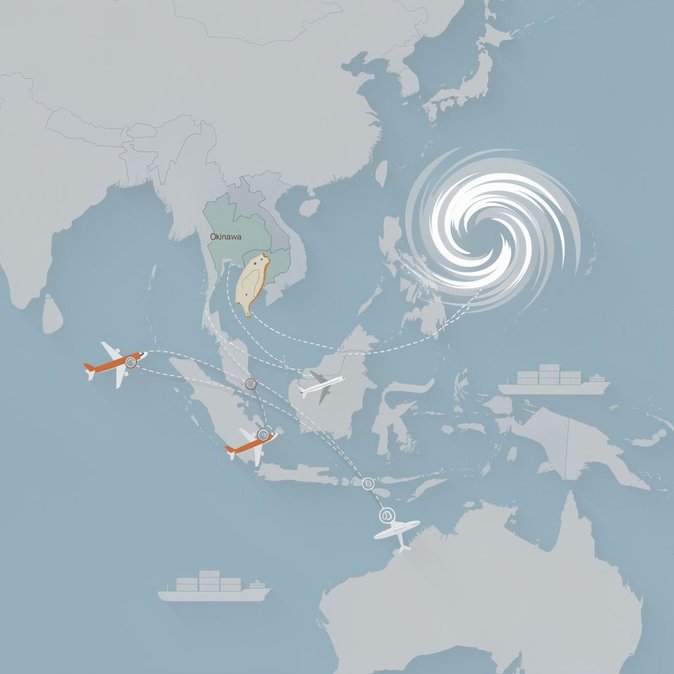
Air traffic across the northern part of the South China Sea is bracing for severe disruption as Super Typhoon Bavi tracks toward Taiwan and the East China coast. Hong Kong-based carriers began activating their extreme-weather playbooks on Wednesday evening (July 8). Hong Kong Airlines announced the outright cancellation of ten round-trip services between Hong Kong and Taipei as well as Hong Kong and Okinawa scheduled for Friday and Saturday. Greater Bay Airlines and HK Express issued parallel alerts urging passengers to monitor e-mails and flight-status pages before heading to the airport. Cathay Pacific, the city’s dominant long-haul airline, stopped short of mass cancellations but introduced wide-ranging “flexible ticket conditions”. Under the waiver, customers holding Cathay-issued tickets dated on or before 8 July for travel to, from or via Taipei, Kaohsiung and six East-China cities (Fuzhou, Wenzhou, Ningbo, Hangzhou, Shanghai and Nanjing) between 9-12 July may rebook or reroute without service fees, provided travel is completed by 31 August. Any fare or tax difference still applies. The policy was last updated at 22:52 HKT on 8 July, underscoring the fast-moving operational environment. Hong Kong International Airport handled more than 125,000 passengers per day in June; summer peaks routinely top that figure as families travel during school holidays. Business travellers heading to the Taiwan Strait manufacturing corridor or the Yangtze River Delta—a critical supply-chain artery for electronics and apparel—should anticipate knock-on delays well beyond the 9-12 July window. Cargo operators have already begun shifting high-value shipments to freighters routed via Chongqing and Shenzhen to avoid potential bottlenecks at Hong Kong and Taipei. Companies with regional mobility programmes are advised to: 1) activate traveller-tracking tools for staff ticketed to East Asia this week; 2) remind employees that Hong Kong’s Airport Express train may suspend service at short notice under a T8 or higher storm signal; and 3) consult marine insurers if time-sensitive cargo is moving through Hong Kong port, where pilotage services are curtailed in typhoon conditions. With climate-driven weather volatility rising, multinational firms increasingly list “super-typhoon contingency planning” as a core component of their Asia-Pacific travel-risk policies.