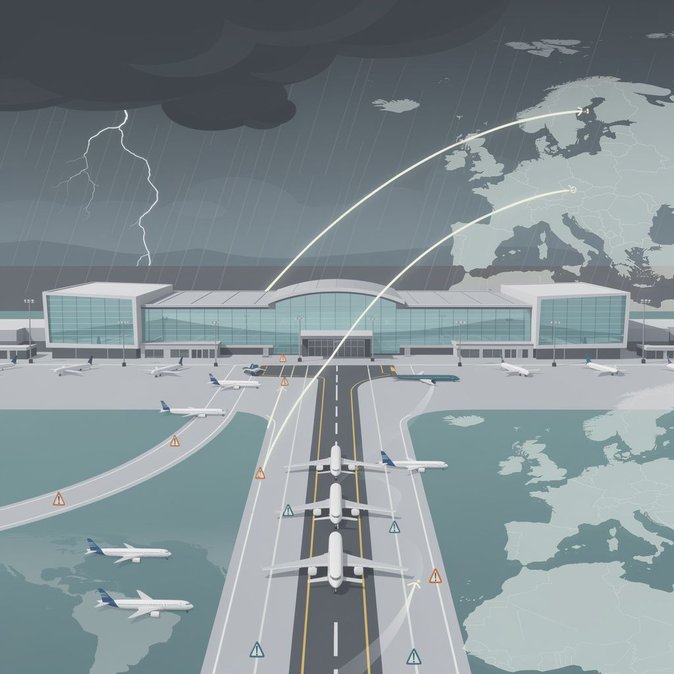
Dublin Airport suffered one of its worst punctuality days of the summer on 8 July 2026, with 192 delayed departures or arrivals and six outright cancellations. According to data compiled by travel analytics outlet Nomad Lawyer, the knock-on disruption rippled across Europe and North America, affecting services operated by Ryanair, Aer Lingus, British Airways, Lufthansa, KLM and Emirates. The bulk of the delays – averaging 69 minutes – occurred in the early-morning peak when a band of Atlantic squalls forced tactical ground-handling halts and runway-sequencing gaps. While weather was the immediate trigger, airline operations managers blame structural constraints at Dublin, which is already operating close to its 32 million-passenger planning cap while its owner, daa, awaits regulatory clearance for a capacity uplift. With most aircraft scheduled to operate several legs per day, a one-hour morning slip rapidly reverberated across the network; Aer Lingus confirmed that delays on EI 105 to New York and EI 115 to Boston forced late-evening returns to depart after midnight, breaching U.S. curfews and disrupting crew-duty rosters. Business travellers were particularly exposed. A delayed EI 631 service to London City missed its Heathrow connection window for the morning Asia-bound banks, obliging several multinational executives to overnight in the U.K. Consulting firm Global Mobility Partners estimates that each wide-body delay at Dublin costs employers €45 000 in lost productivity, hotel re-accommodation and missed meetings. Travellers can mitigate some of the risk by booking longer connection windows, using Dublin’s ‘flight-aware’ security Fast Track lane, and registering for EC 261 compensation where eligible. daa says a €250 million airfield optimisation programme – including additional rapid-exit taxiways and an enlarged stand-allocation system – is due to be operational by summer 2027, but airlines warn that another two peak seasons of congestion remain likely. For mobility managers, the episode is a reminder to build contingency time into itineraries and to monitor live data feeds rather than relying solely on published schedules.
Source: Nomad Lawyer