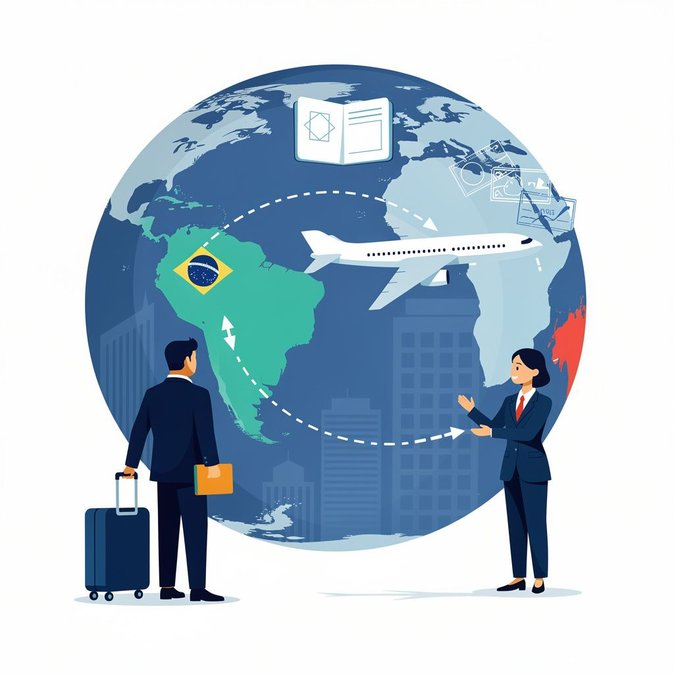
Meeting in Asunción on 8 July, heads of state of the Mercosur bloc—Brazil, Argentina, Paraguay and Uruguay—formally endorsed the start of negotiations on a Japan–Mercosur Free Trade Agreement. The decision, reported by Japan External Trade Organization (JETRO), gives Brasília a fresh channel to deepen commercial ties with the world’s third-largest economy just weeks after Brazil concluded internal procedures to implement the long-delayed EU–Mercosur accord.
Business travellers eager to get ahead of the curve can already streamline today’s paperwork through VisaHQ, which handles Japanese business visas for Brazilian passport holders entirely online and will update its tools as soon as any Mercosur–Japan mobility provisions enter into force. See for step-by-step guidance, document checklists and expedited filing options.
Although trade liberalisation headlines the agenda, negotiators confirmed that a dedicated chapter on temporary entry of businesspersons will mirror provisions found in Japan’s EPAs with Mexico and Chile. That could translate into multi-year, multi-entry visas for intra-corporate transferees, investors and service suppliers—an upgrade from the 90-day, single-entry business visa most Brazilian executives must currently secure for Japan. At present, Brazil has no bilateral visa-waiver or trusted-traveller arrangement with Tokyo. Brazilian multinationals in agribusiness, machinery and IT services stand to benefit first. Apex-Brasil estimates that streamlining work permits and recognition of professional qualifications could save exporters up to US$27 million a year in compliance costs, while cutting project-deployment timelines in Japan by 30 %. The promise of easier mobility also dovetails with São Paulo state’s plan to attract Japanese semiconductor suppliers to its new tech cluster in Campinas. Diplomatically, the announcement helps President Luiz Inácio Lula da Silva showcase Mercosur’s relevance amid criticism that individual members—Uruguay in particular—have sought unilateral deals outside the bloc. By pursuing a high-profile Asian partner collectively, Mercosur’s four core members hope to strengthen their negotiating leverage and avoid a patchwork of differing mobility regimes that complicate HR planning for regional headquarters in São Paulo. The first negotiating round is expected in Brasília in September, with sub-groups on market access, sanitary standards and mobility running in parallel. Companies with upcoming assignments to Japan should watch for interim measures: Brazilian officials hinted that an electronic pre-clearance system for short-stay business visas could be piloted before a full treaty is ratified—potentially as early as late 2027.
Business travellers eager to get ahead of the curve can already streamline today’s paperwork through VisaHQ, which handles Japanese business visas for Brazilian passport holders entirely online and will update its tools as soon as any Mercosur–Japan mobility provisions enter into force. See for step-by-step guidance, document checklists and expedited filing options.
Although trade liberalisation headlines the agenda, negotiators confirmed that a dedicated chapter on temporary entry of businesspersons will mirror provisions found in Japan’s EPAs with Mexico and Chile. That could translate into multi-year, multi-entry visas for intra-corporate transferees, investors and service suppliers—an upgrade from the 90-day, single-entry business visa most Brazilian executives must currently secure for Japan. At present, Brazil has no bilateral visa-waiver or trusted-traveller arrangement with Tokyo. Brazilian multinationals in agribusiness, machinery and IT services stand to benefit first. Apex-Brasil estimates that streamlining work permits and recognition of professional qualifications could save exporters up to US$27 million a year in compliance costs, while cutting project-deployment timelines in Japan by 30 %. The promise of easier mobility also dovetails with São Paulo state’s plan to attract Japanese semiconductor suppliers to its new tech cluster in Campinas. Diplomatically, the announcement helps President Luiz Inácio Lula da Silva showcase Mercosur’s relevance amid criticism that individual members—Uruguay in particular—have sought unilateral deals outside the bloc. By pursuing a high-profile Asian partner collectively, Mercosur’s four core members hope to strengthen their negotiating leverage and avoid a patchwork of differing mobility regimes that complicate HR planning for regional headquarters in São Paulo. The first negotiating round is expected in Brasília in September, with sub-groups on market access, sanitary standards and mobility running in parallel. Companies with upcoming assignments to Japan should watch for interim measures: Brazilian officials hinted that an electronic pre-clearance system for short-stay business visas could be piloted before a full treaty is ratified—potentially as early as late 2027.