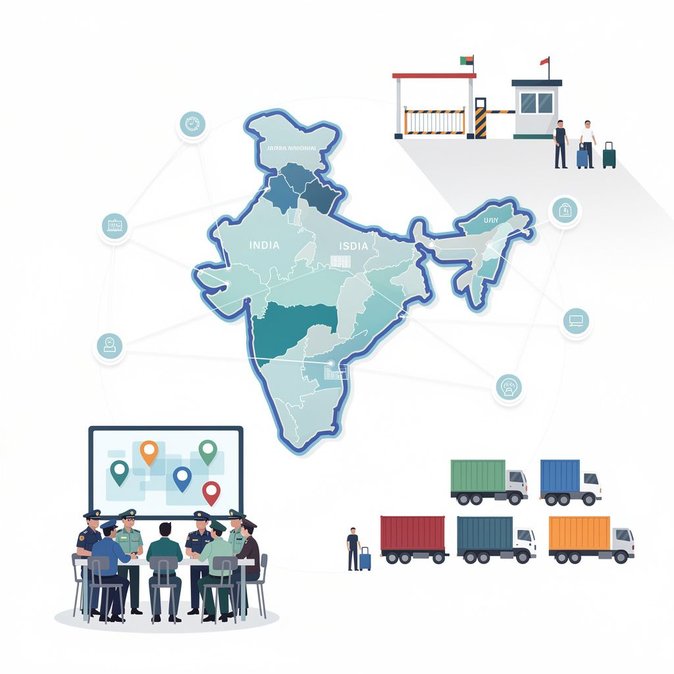
India’s Union Home Minister Amit Shah will address more than 150 Superintendents of Police (SPs) from districts that share international borders with Pakistan, Bangladesh, Nepal, Bhutan and Myanmar at a high-level conference in New Delhi on 9 July 2026. The day-long meeting—nicknamed the ‘Border District SPs Conference 2026’—will review illegal infiltration trends, intelligence coordination and the status of Integrated Check-Posts (ICPs) under construction. Officials told India Today the agenda includes fast-tracking deployment of Advanced Integrated Peripheral Surveillance Systems, beefing up biometric capture at land ports and aligning district policing with the national Immigration, Visa, Foreigners Registration & Tracking (IVFRT) database. Particular focus will be placed on the Indo-Bangladesh frontier, which has seen a 27 % jump in counterfeit travel documents over the past year, and on the northeastern borders where porous terrain complicates enforcement. For corporates operating in special-economic zones near borders, tighter controls could translate into longer cargo-truck clearance times in the short term but improved security in the long run. HR teams relocating staff to these areas may face additional police-verification steps as local SPs implement uniform Standard Operating Procedures discussed at the conference. The meeting is also expected to clear a proposal to expand Foreigners Regional Registration Offices (FRROs) to every state capital by 2027—a measure long demanded by multinationals who currently have to fly talent to metros for visa extensions. In addition, the Home Minister will review progress on community engagement programmes aimed at discouraging residents from facilitating irregular crossings. Analysts view the gathering as an operational follow-up to the continuation of the IVFRT scheme approved earlier this year, signalling that New Delhi is pairing high-tech platforms with boots-on-ground policing to plug migration gaps. Businesses with cross-border supply chains should monitor outcome documents for any new documentation requirements at land borders.
Source: India Today