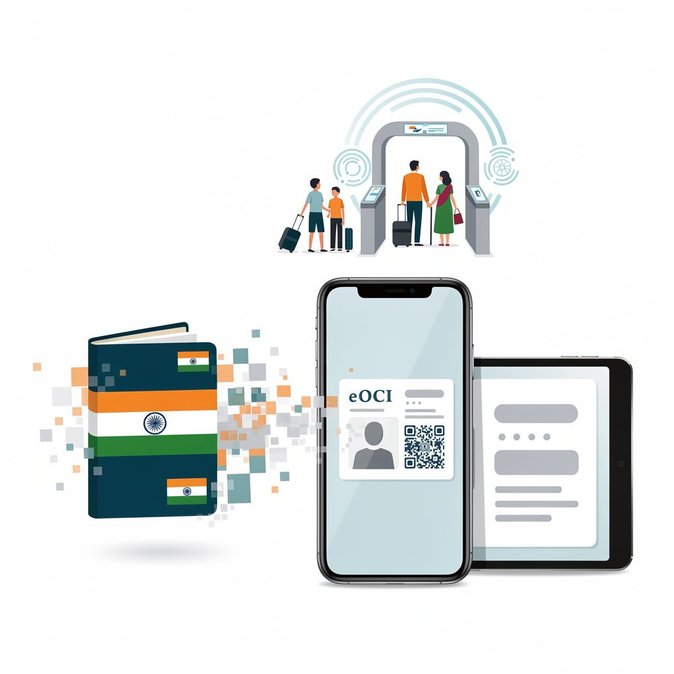
From 8 July 2026, all new Overseas Citizen of India (OCI) registrations will be issued exclusively in digital form, branded the “e-OCI Card.” The Bureau of Immigration (BoI) announced the transition after a successful six-month pilot. Existing physical OCI booklets remain valid, but holders no longer need to carry them; an electronic copy stored on a mobile device alongside the linked passport will suffice at immigration checkpoints.
The e-OCI rollout is the latest step in India’s broader digitisation of consular services, following e-passports and online FRRO extensions. Under the new regime, applicants complete the entire OCI process online—biographic entry, document upload, fee payment and appointment scheduling for biometric capture where required.
For applicants who prefer expert assistance navigating the all-online filing system, VisaHQ’s India desk offers end-to-end support—from document vetting and photo compliance to real-time status tracking—ensuring e-OCI approvals arrive on schedule for upcoming trips.
Personal interviews are now mandatory only for spouse-based OCI applications; most other categories are fully remote. For the 6 million-plus global OCI community—and the multinational companies that employ them—the change simplifies travel logistics. OCI employees transiting between overseas headquarters and Indian subsidiaries often struggled with damaged or misplaced booklets; a cloud-stored credential mitigates that risk and speeds airline document checks.
Cost savings are also notable: the government has scrapped the ₹ 1,000 re-issuance fee previously charged when renewing an OCI after a new passport. Technology teams at major Indian airports have integrated e-OCI QR codes into Digi-Yatra facial-recognition corridors, promising sub-30-second clearance times.
Airlines are updating DCS (Departure Control System) software to scan the 2D barcode embedded in each digital card. Mobility managers should train travel approvers and educate travellers on downloading the e-OCI PDF and keeping phone batteries charged on arrival.
Looking ahead, the Home Ministry aims to link e-OCI data with India’s Advance Passenger Information System and Customs’ digital declaration platform, creating a seamless “green lane” for the diaspora. Stakeholders should monitor further circulars that may formalise this integrated entry stream.
The e-OCI rollout is the latest step in India’s broader digitisation of consular services, following e-passports and online FRRO extensions. Under the new regime, applicants complete the entire OCI process online—biographic entry, document upload, fee payment and appointment scheduling for biometric capture where required.
For applicants who prefer expert assistance navigating the all-online filing system, VisaHQ’s India desk offers end-to-end support—from document vetting and photo compliance to real-time status tracking—ensuring e-OCI approvals arrive on schedule for upcoming trips.
Personal interviews are now mandatory only for spouse-based OCI applications; most other categories are fully remote. For the 6 million-plus global OCI community—and the multinational companies that employ them—the change simplifies travel logistics. OCI employees transiting between overseas headquarters and Indian subsidiaries often struggled with damaged or misplaced booklets; a cloud-stored credential mitigates that risk and speeds airline document checks.
Cost savings are also notable: the government has scrapped the ₹ 1,000 re-issuance fee previously charged when renewing an OCI after a new passport. Technology teams at major Indian airports have integrated e-OCI QR codes into Digi-Yatra facial-recognition corridors, promising sub-30-second clearance times.
Airlines are updating DCS (Departure Control System) software to scan the 2D barcode embedded in each digital card. Mobility managers should train travel approvers and educate travellers on downloading the e-OCI PDF and keeping phone batteries charged on arrival.
Looking ahead, the Home Ministry aims to link e-OCI data with India’s Advance Passenger Information System and Customs’ digital declaration platform, creating a seamless “green lane” for the diaspora. Stakeholders should monitor further circulars that may formalise this integrated entry stream.