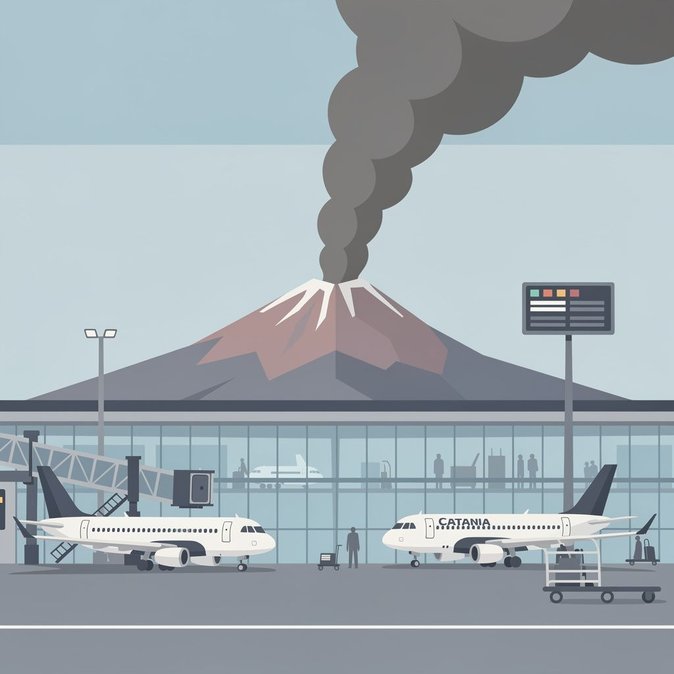
For the second time in a week Sicily’s busiest airport, Catania–Fontanarossa, has closed its runway due to a persistent ash cloud from Mount Etna’s ongoing strombolian eruption. The airport authority announced at 07:00 on 9 July that all arrivals and departures were suspended until at least 18:00, later warning the ban could be extended if winds fail to disperse the particles. The nearby military and NATO facility at Sigonella has also halted operations. Airlines have scrambled to divert or cancel more than 80 flights so far. Ryanair has rerouted services to Trapani and Palermo, Norwegian has sent an Oslo flight to Palermo, and ITA Airways has notified passengers of significant knock-on delays across its network.
If the volcanic disruption forces you to reroute through other European airports or extend your stay in Italy, VisaHQ can help you secure any additional travel documents quickly and painlessly. From Schengen extensions to transit visas for neighboring countries, the online platform simplifies applications, offers real-time status updates, and provides expert support—vital when your itinerary changes at the last minute. Learn more at
Over 10,000 travellers are affected, many of them holidaymakers and offshore-energy workers who use Catania as a hub for crew changes. Etna has been ejecting ash intermittently since late June, forcing repeated closures that are stretching the airport’s operational resilience. Local hoteliers report an uptick in same-day cancellations, and logistics companies moving perishables such as Sicilian citrus fruit complain of mounting costs as time-sensitive cargo is re-routed via road to Palermo. Under EU Regulation 261, passengers whose flights are cancelled because of volcanic ash are not entitled to financial compensation, but airlines must provide care, meals and hotel accommodation if necessary. Corporate travel managers are advising employees to avoid itineraries that rely on Catania for the next 48 hours and to consider remote working alternatives. Authorities are monitoring the eruption with the Italian Civil Protection Department and the INGV volcanology institute. If seismic tremors intensify, further closures and wider air-space restrictions around eastern Sicily are possible, adding uncertainty for summer schedules.
If the volcanic disruption forces you to reroute through other European airports or extend your stay in Italy, VisaHQ can help you secure any additional travel documents quickly and painlessly. From Schengen extensions to transit visas for neighboring countries, the online platform simplifies applications, offers real-time status updates, and provides expert support—vital when your itinerary changes at the last minute. Learn more at
Over 10,000 travellers are affected, many of them holidaymakers and offshore-energy workers who use Catania as a hub for crew changes. Etna has been ejecting ash intermittently since late June, forcing repeated closures that are stretching the airport’s operational resilience. Local hoteliers report an uptick in same-day cancellations, and logistics companies moving perishables such as Sicilian citrus fruit complain of mounting costs as time-sensitive cargo is re-routed via road to Palermo. Under EU Regulation 261, passengers whose flights are cancelled because of volcanic ash are not entitled to financial compensation, but airlines must provide care, meals and hotel accommodation if necessary. Corporate travel managers are advising employees to avoid itineraries that rely on Catania for the next 48 hours and to consider remote working alternatives. Authorities are monitoring the eruption with the Italian Civil Protection Department and the INGV volcanology institute. If seismic tremors intensify, further closures and wider air-space restrictions around eastern Sicily are possible, adding uncertainty for summer schedules.