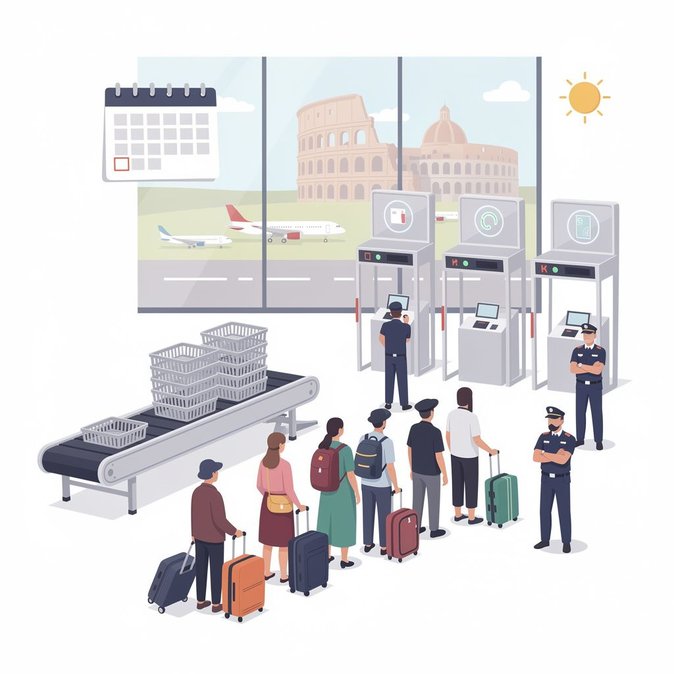
Travellers passing through Rome’s Fiumicino and Ciampino airports on 9 July faced unusually long waits as ADR Security personnel stopped work for a full 24 hours. The protest, notified at 12:58 on 9 July in the Ministry of Transport’s database, involved screening officers responsible for hand-luggage x-ray, metal-detectors and secondary searches.
Should the disruption force passengers to reroute or adjust stopovers, managing visa paperwork at short notice can become an added hassle. VisaHQ offers fast online processing, up-to-date entry requirements and courier services for Italian and onward visas, giving travellers and corporate mobility teams a reliable back-up when flight schedules suddenly change.
Although airport operator Aeroporti di Roma mobilised supervisors and temporary staff, passenger throughput at peak morning waves fell by an estimated 40 %, according to airline ground-handling sources. Priority lanes for families and crew remained open but business-class fast-track privileges were suspended. Several airlines issued travel advisories asking travellers to arrive at least three hours before domestic departures and four for intercontinental flights. The stoppage coincided with the first major holiday exodus since the EU Entry/Exit System became mandatory in April, compounding bottlenecks at passport control. Unions FILCAMS-CGIL and FIT-CISL demand hazard-pay supplements and new hiring to cope with biometric-check workloads. ADR says it has already tabled a 7 % wage increase and funded 120 additional full-time positions but insists pay rises must be linked to productivity metrics. For corporate mobility managers, the episode highlights the interplay between security staffing and the new EES regime. Companies sending staff through Rome this summer should schedule meetings after midday, book flexible tickets and remind travellers that missed connections caused by security queues are rarely covered by insurance. Talks are scheduled for 15 July at Italy’s National Conciliation Office; failure could trigger further 48-hour strikes in August, traditionally Rome’s busiest month for inbound long-haul tourism and diplomatic travel.
Should the disruption force passengers to reroute or adjust stopovers, managing visa paperwork at short notice can become an added hassle. VisaHQ offers fast online processing, up-to-date entry requirements and courier services for Italian and onward visas, giving travellers and corporate mobility teams a reliable back-up when flight schedules suddenly change.
Although airport operator Aeroporti di Roma mobilised supervisors and temporary staff, passenger throughput at peak morning waves fell by an estimated 40 %, according to airline ground-handling sources. Priority lanes for families and crew remained open but business-class fast-track privileges were suspended. Several airlines issued travel advisories asking travellers to arrive at least three hours before domestic departures and four for intercontinental flights. The stoppage coincided with the first major holiday exodus since the EU Entry/Exit System became mandatory in April, compounding bottlenecks at passport control. Unions FILCAMS-CGIL and FIT-CISL demand hazard-pay supplements and new hiring to cope with biometric-check workloads. ADR says it has already tabled a 7 % wage increase and funded 120 additional full-time positions but insists pay rises must be linked to productivity metrics. For corporate mobility managers, the episode highlights the interplay between security staffing and the new EES regime. Companies sending staff through Rome this summer should schedule meetings after midday, book flexible tickets and remind travellers that missed connections caused by security queues are rarely covered by insurance. Talks are scheduled for 15 July at Italy’s National Conciliation Office; failure could trigger further 48-hour strikes in August, traditionally Rome’s busiest month for inbound long-haul tourism and diplomatic travel.