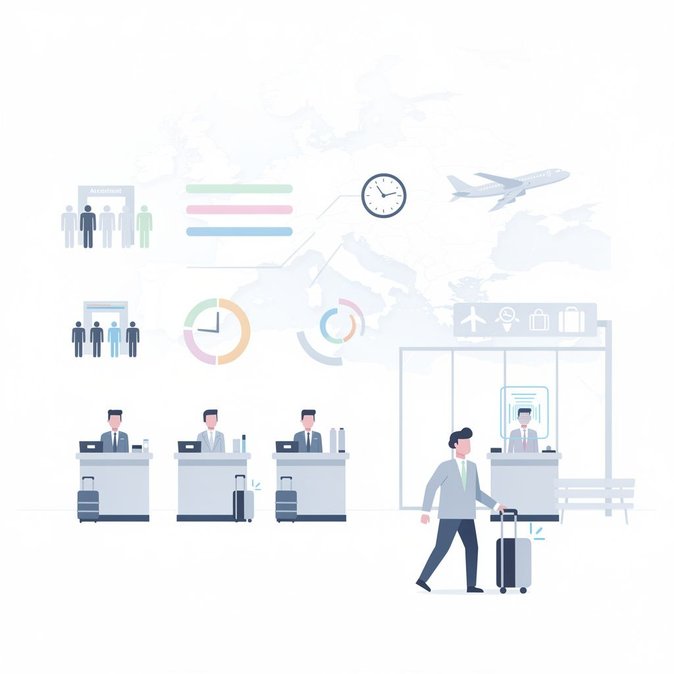
A new tech tool aimed at easing Schengen border bottlenecks went live late on 10 July 2026, when travel-data start-up FlightQueue added Vienna International Airport (VIE) to its real-time passport-control and security-wait service. The dashboard predicts queue lengths for security, check-in and—crucially—the EU’s new Entry/Exit System (EES) kiosks that non-EU travellers must now use on first arrival. Early readings on 11 July showed average security waits of 23 minutes and EES-linked immigration waits of just four minutes, with the platform labelling conditions “Normal/Fast”. FlightQueue draws on sensor feeds, airline API data and voluntary user reports to forecast bottlenecks hour-by-hour; it already covers Frankfurt, Paris-CDG and Madrid but is the first external service to provide Viennese travellers with granular EES metrics. For business-travel managers and relocation providers the launch is timely: Vienna’s summer passenger volumes are running 14 % above 2025 levels, and the airport warns that first-time biometric enrolment can add 3-5 minutes per traveller. Armed with FlightQueue’s analytics, companies can schedule earlier airport pickups, adjust meeting times or steer travellers toward mid-day departures, which the data shows to be the least congested. More broadly, the roll-out illustrates how private tech platforms are filling information gaps left by governments as the EU transitions to EES and, from 2027, ETIAS. Similar live dashboards are likely to appear for Salzburg and Innsbruck once those airports finish installing biometric gates later this year. The trend will push airports—and perhaps regulators—to share more operational data in real time, a development that mobility stakeholders should welcome. FlightQueue says it will add crowd-sourced kiosk-malfunction alerts and 90/180-day Schengen stay trackers before the end of Q3, further integrating compliance and traveller-experience features in a single interface.
Source: FlightQueue