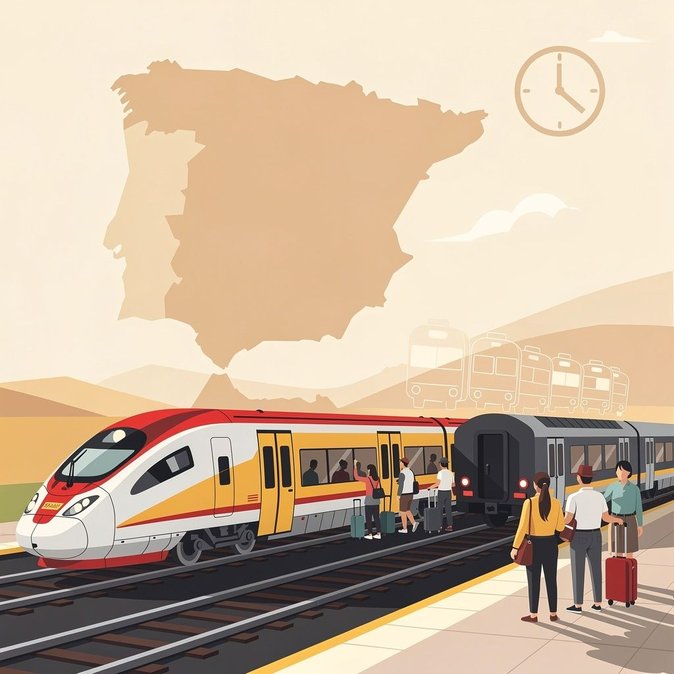
With only four days’ notice, Spain’s Ministry of Transport and Mobility has published legally binding minimum-service levels for the 24-hour rail strike called by the Sindicato Ferroviario for Monday, 15 July. The walk-out affects Renfe’s entire national network, including Cercanías commuter trains, Media Distancia regional services and the AVE/Alvia high-speed lines that connect Madrid with Barcelona, Seville, Valencia and beyond. Authorities have ordered that 75 % of peak-hour Cercanías services, 66 % of regional trains and 73 % of high-speed and long-distance departures must operate.
For travellers holding non-EU passports, last-minute changes to itineraries can raise questions about visa validity or Schengen stay limits. VisaHQ’s Spain portal provides a quick way to check entry requirements, extend permissions or arrange transit visas online, meaning mobility managers can keep disrupted employees compliant while they adjust their travel plans.
In raw numbers, that equates to 426 of the 650 scheduled Media Distancia services and 249 of the 343 AVE/Alvia trains. Renfe is already re-booking affected passengers or offering refunds for the 318 trains likely to be cancelled. Although the union behind the stoppage is small—its last action on 29 June attracted only 1.83 % participation—the government is taking no chances at the height of the summer season, when rail capacity is critical for tourism flows and domestic business travel. The strike coincides with the first full working day after the San Fermín festival, when thousands of visitors traditionally leave Pamplona for Madrid and Barcelona. Corporate mobility teams should alert travellers with bookings on 15 July to check train status 24 hours beforehand and consider switching to flights or long-distance coaches where feasible. Renfe’s ticket-change policy allows free re-routing onto the next available train within 30 days, but seat availability on popular Madrid–Barcelona and Madrid–Seville corridors will be tight. For international assignees and expatriate families relying on Spain’s high-speed network, the key takeaway is that most services will still run, but journey times and connections could be disrupted. Employers may wish to authorise hotel overnights or remote-working arrangements for staff whose itineraries fall on the strike day.
For travellers holding non-EU passports, last-minute changes to itineraries can raise questions about visa validity or Schengen stay limits. VisaHQ’s Spain portal provides a quick way to check entry requirements, extend permissions or arrange transit visas online, meaning mobility managers can keep disrupted employees compliant while they adjust their travel plans.
In raw numbers, that equates to 426 of the 650 scheduled Media Distancia services and 249 of the 343 AVE/Alvia trains. Renfe is already re-booking affected passengers or offering refunds for the 318 trains likely to be cancelled. Although the union behind the stoppage is small—its last action on 29 June attracted only 1.83 % participation—the government is taking no chances at the height of the summer season, when rail capacity is critical for tourism flows and domestic business travel. The strike coincides with the first full working day after the San Fermín festival, when thousands of visitors traditionally leave Pamplona for Madrid and Barcelona. Corporate mobility teams should alert travellers with bookings on 15 July to check train status 24 hours beforehand and consider switching to flights or long-distance coaches where feasible. Renfe’s ticket-change policy allows free re-routing onto the next available train within 30 days, but seat availability on popular Madrid–Barcelona and Madrid–Seville corridors will be tight. For international assignees and expatriate families relying on Spain’s high-speed network, the key takeaway is that most services will still run, but journey times and connections could be disrupted. Employers may wish to authorise hotel overnights or remote-working arrangements for staff whose itineraries fall on the strike day.