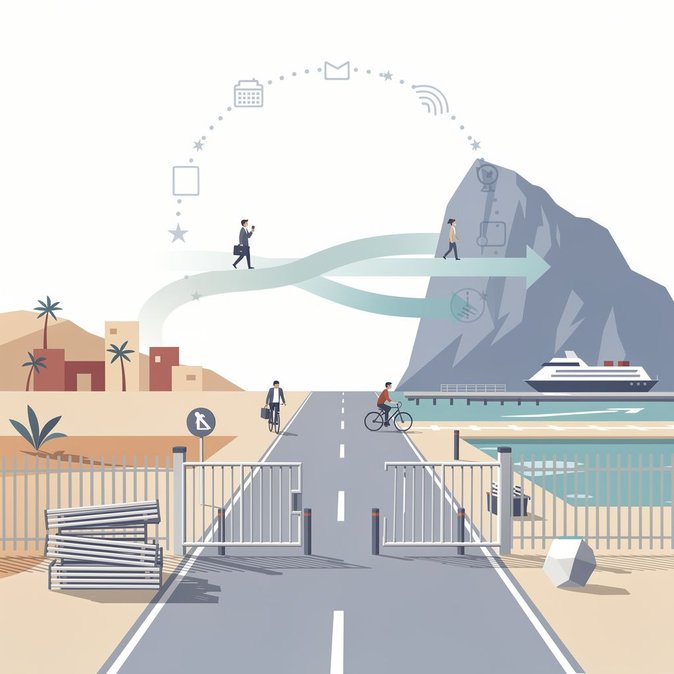
After more than half a century as an emblem of political tension, the 1.2-kilometre fence that marks the land border between Spain and Gibraltar will disappear this coming 15 July. According to details released on 11 July, Spanish and Gibraltarian authorities have now completed the operational plan that will transfer passport checks away from the land crossing to Gibraltar’s port and airport. From next week, travellers will drive or walk freely across the isthmus for the first time since the 1950s, while joint Spanish–Gibraltar (and therefore EU) controls will be performed air- and seaports side. The change is the first visible result of the EU–UK treaty on Gibraltar agreed in February 2026. Under the pact, Gibraltar joins the Schengen area in everything but name: Schengen rules will apply, Frontex officers will support Spanish police in carrying out immigration checks, and the territory will align with EU customs regulations for goods. In practice, this means border-free mobility for the 15,000 Spanish cross-border workers and for the millions of tourists who combine the Costa del Sol with a day trip to “the Rock”. For companies running shuttles or coach excursions, the disappearance of the notorious queues that could stretch for hours is a game-changer. Trade associations in nearby La Línea estimate that lost working time at the gate has cost the Campo de Gibraltar economy more than €70 million a year. Hoteliers on both sides also expect longer average stays now that day-trippers will not fear being stranded in traffic. Businesses should, however, review documentation routines. Although vehicles will no longer be inspected at the fence, passengers entering Gibraltar by land will technically be inside the customs territory of the EU and must still respect Schengen over-stay limits. Non-EU travellers will need to register via the EU’s Entry/Exit System (EES) installed at Gibraltar airport and port; biometric kiosks are already in place. Logistics operators will feel the impact from 15 July too. EU goods entering Gibraltar will circulate under a new electronic T2GI transit declaration, while Spanish exporters must register with Gibraltar’s ASYCUDA customs platform. Madrid and London have set a six-month transition period during which dual Spanish–Gibraltar customs teams can carry out spot checks to fine-tune the system.
Source: AS