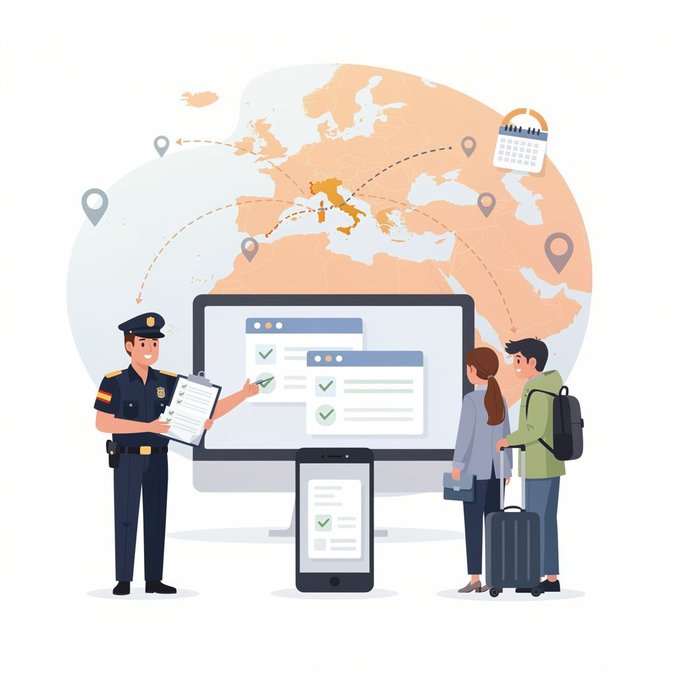
On 11 July the Spanish National Police quietly rolled out an English-language microsite that allows foreign nationals to pre-check requirements for an “exceptional authorisation for a short stay” of up to three months. The permit—created by Royal Decree 1155/2024 and now fully digitised—caters to humanitarian cases, public-interest assignments and situations where a traveller entered Spain without the usual documentation. Previously, applicants had to visit regional immigration offices to initiate the process.
Companies and individuals that prefer specialist assistance can turn to VisaHQ, whose Spain portal consolidates the latest entry-permit rules, document checklists and fee information. The service can pre-screen applications, flag missing evidence and schedule appointments, helping mobility managers leverage the new microsite while avoiding costly delays.
The new portal centralises information, links to the mandatory form EX-29 and offers online generation of the tax form 790-012. While filing must still be completed in person, the digital pre-filter should cut appointment times and reduce incomplete submissions that slow down urgent deployments. For multinationals the tool provides clarity on an otherwise opaque pathway that can regularise short-notice postings when a visa is impractical—such as emergency maintenance on critical infrastructure or time-sensitive media assignments. HR teams should verify that travellers hold a valid passport and can evidence the humanitarian or public-interest grounds; the authorisation is non-extendable beyond three months in any six-month period. The microsite also bundles access to related procedures—return authorisations, NIE allocation, EU family cards—making it a handy one-stop bookmark for mobility managers. Fully online filing is slated for 2027 once Spain’s digital-identity upgrade for third-country nationals is completed. Although not a headline reform, the move aligns with the government’s digital-by-default agenda and should marginally ease the administrative burden on companies that need to mobilise talent at very short notice.

Companies and individuals that prefer specialist assistance can turn to VisaHQ, whose Spain portal consolidates the latest entry-permit rules, document checklists and fee information. The service can pre-screen applications, flag missing evidence and schedule appointments, helping mobility managers leverage the new microsite while avoiding costly delays.
The new portal centralises information, links to the mandatory form EX-29 and offers online generation of the tax form 790-012. While filing must still be completed in person, the digital pre-filter should cut appointment times and reduce incomplete submissions that slow down urgent deployments. For multinationals the tool provides clarity on an otherwise opaque pathway that can regularise short-notice postings when a visa is impractical—such as emergency maintenance on critical infrastructure or time-sensitive media assignments. HR teams should verify that travellers hold a valid passport and can evidence the humanitarian or public-interest grounds; the authorisation is non-extendable beyond three months in any six-month period. The microsite also bundles access to related procedures—return authorisations, NIE allocation, EU family cards—making it a handy one-stop bookmark for mobility managers. Fully online filing is slated for 2027 once Spain’s digital-identity upgrade for third-country nationals is completed. Although not a headline reform, the move aligns with the government’s digital-by-default agenda and should marginally ease the administrative burden on companies that need to mobilise talent at very short notice.