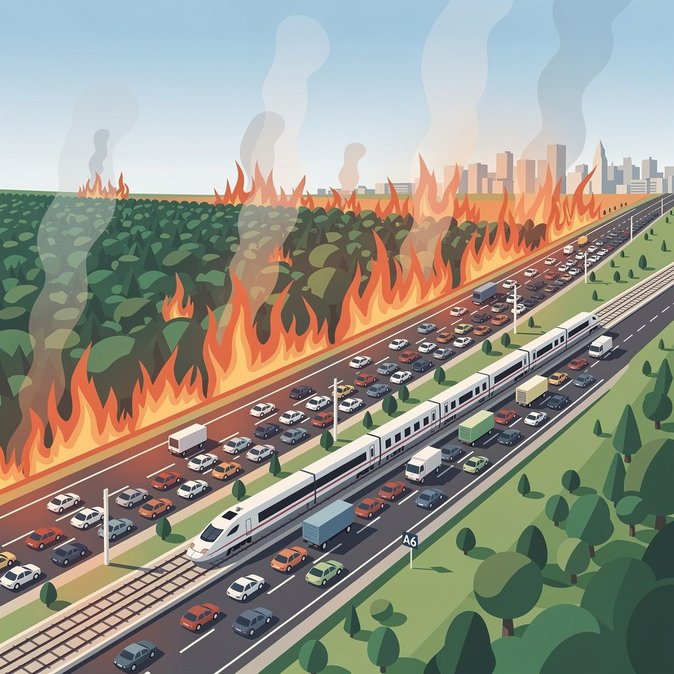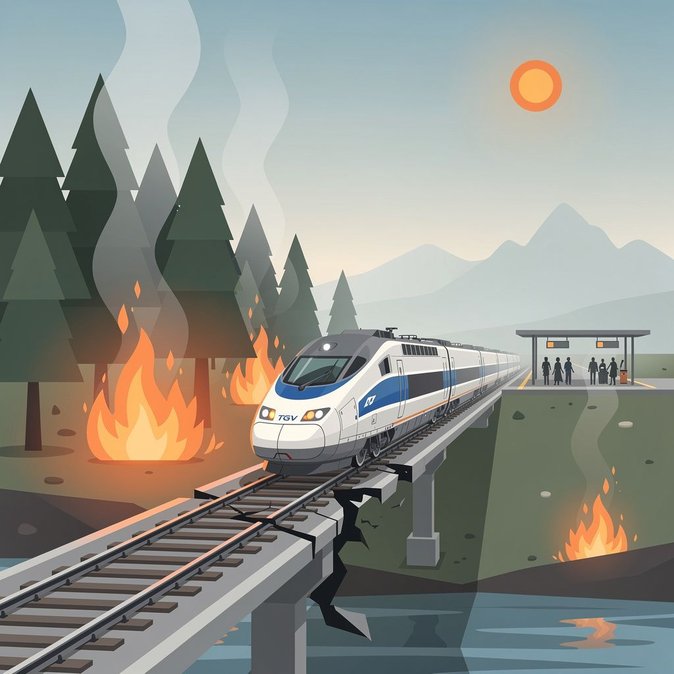
A severe forest fire near Fontainebleau, south of Paris, forced SNCF to suspend high-speed services on the LGV Sud-Est on Sunday, 12 July, detouring trains onto slower classic lines and stranding thousands of passengers at Paris-Gare-de-Lyon. According to transport outlet Economie Matin, some TGV Inoui, Ouigo and Lyria services recorded delays of up to six hours, while five south-bound trains were cancelled outright. Road traffic also suffered as sections of the A6 and A5 motorways were closed to allow firefighting aircraft access. Overnight, SNCF Réseau engineers repaired heat-damaged signalling cables, enabling partial resumption of high-speed traffic on Monday morning. By 10:00, most departures were operating with residual delays of one to two hours, and the operator predicted a full return to timetable by mid-afternoon. Nevertheless, crews and rolling stock remained out of position, prompting SNCF to waive exchange fees and remind travellers of compensation rights under the ‘Garantie Ponctualité’ scheme (25 % refund for delays over 30 minutes, 50 % over two hours). The incident underscores the growing climate-risk exposure of French rail infrastructure. July’s record heat has left vegetation tinder-dry, increasing the likelihood of fires along rail corridors. Business-travel consultants advise companies to monitor SNCF’s real-time disruption feed and to favour early-morning departures—which run before peak heat—when booking essential trips during the current red-alert period. International knock-on effects were also felt: Swiss operator SBB reported missed connections for Lyria passengers heading to Geneva and Zürich, while Italian rail carrier Trenitalia confirmed that its Paris–Milan Frecciarossa service experienced a three-hour delay. Airlines saw a modest uptick in last-minute bookings between Paris Orly and Lyon St-Exupéry as travellers sought alternatives. Longer term, the transport ministry is evaluating additional fire-break clearance around key rail arteries and has signalled that heat-resilience will be a core theme of its forthcoming ‘Plan Rail 2030’.
Source: Economie Matin