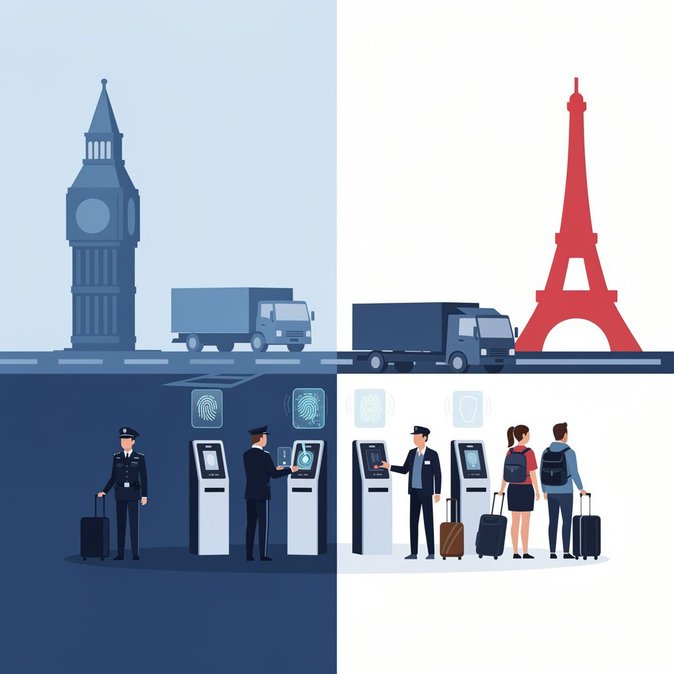
With just weeks to go before the new EU Entry/Exit System (EES) begins a live test phase, Paris and London have struck a last-minute deal to bolster staffing at juxtaposed border posts in Dover, Folkestone and London-St Pancras, as well as in Calais and at Paris-Nord Eurostar terminal. According to the UK Department for Transport, France will station an additional 120 Police aux Frontières officers on British soil from 19 July, while the UK will fund a further 20 biometric kiosks and fast-track lanes.
Travellers who are unsure how the EES might change their own documentation needs can turn to VisaHQ for quick, up-to-date advice. The company’s easy-to-use portal—see the France section at you check requirements, order visas or transit permits, and receive alerts about new biometric rules, making it a useful safety net for both frequent flyers and first-time visitors.
The agreement follows growing alarm among ferry operators, Eurotunnel and Eurostar that fingerprinting and facial-recognition checks could add two minutes per passenger and trigger kilometre-long queues during the peak holiday season. A simulation by ferry lobby Interferry suggested wait times could reach four hours on Saturdays if no counter-measures were taken. French officials say the extra staff will give them flexibility to revert to fully manual stamping if biometric kiosks fail—an issue that affected Paris-Charles-de-Gaulle earlier this month. The deal also includes a shared incident-management cell and a commitment to open all booths during red-traffic weekends identified by Bison Futé. For employers moving talent or equipment across the Channel, the announcement provides short-term reassurance but does not remove structural risk. Mobility managers are advised to book earlier train slots, brief travellers on biometric capture, and ensure ATA carnets and work-permit paperwork are in order to avoid secondary inspection. Longer term, businesses should watch whether the EU grants a broader derogation for drive-on/drive-off ports, as nine member states—including France—have requested. If the rules are not relaxed by September, carriers warn that freight flows and same-day business trips could be severely curtailed.
Travellers who are unsure how the EES might change their own documentation needs can turn to VisaHQ for quick, up-to-date advice. The company’s easy-to-use portal—see the France section at you check requirements, order visas or transit permits, and receive alerts about new biometric rules, making it a useful safety net for both frequent flyers and first-time visitors.
The agreement follows growing alarm among ferry operators, Eurotunnel and Eurostar that fingerprinting and facial-recognition checks could add two minutes per passenger and trigger kilometre-long queues during the peak holiday season. A simulation by ferry lobby Interferry suggested wait times could reach four hours on Saturdays if no counter-measures were taken. French officials say the extra staff will give them flexibility to revert to fully manual stamping if biometric kiosks fail—an issue that affected Paris-Charles-de-Gaulle earlier this month. The deal also includes a shared incident-management cell and a commitment to open all booths during red-traffic weekends identified by Bison Futé. For employers moving talent or equipment across the Channel, the announcement provides short-term reassurance but does not remove structural risk. Mobility managers are advised to book earlier train slots, brief travellers on biometric capture, and ensure ATA carnets and work-permit paperwork are in order to avoid secondary inspection. Longer term, businesses should watch whether the EU grants a broader derogation for drive-on/drive-off ports, as nine member states—including France—have requested. If the rules are not relaxed by September, carriers warn that freight flows and same-day business trips could be severely curtailed.